

Changing how we solve environmental and social problems starts with bold ideas, not minor tweaks. For young innovators around the world, real progress means going beyond “green” labels and building solutions that truly reshape how communities, economies, and ecosystems work together. If you are driven to create solutions that matter, this guide reveals how sustainable innovation integrates environmental, social, and economic goals, encouraging you to think bigger and act with purpose.
Table of Contents
- Defining Innovation In Sustainability Today
- Types Of Sustainable Innovation And Impact
- Key Characteristics Of Sustainability Innovation
- Harnessing Youth-Driven And Team-Based Solutions
- Risks, Barriers, And Common Pitfalls To Avoid
Key Takeaways
| Point | Details |
|---|---|
| Sustainable Innovation Requires Systemic Change | True sustainable innovation goes beyond improving existing systems to fundamentally redesigning them for greater ecological and social impact. |
| Five Types of Sustainable Innovation | Understanding product, process, technological, organizational, and market innovations allows for targeted solutions addressing diverse sustainability challenges. |
| Youth Engagement and Team Diversity Are Crucial | Utilizing young innovators’ perspectives and forming diverse teams enhances problem-solving capacity and fosters comprehensive, effective solutions. |
| Anticipate Barriers to Implementation | Identifying funding gaps, cooperation issues, and institutional resistance early helps develop strategies for overcoming obstacles in scaling sustainable solutions. |
Defining Innovation in Sustainability Today
Innovation in sustainability means rethinking how we solve problems—not just making incremental tweaks to existing systems. It’s about creating fundamentally different approaches to how we live, produce, and consume resources.
At its core, sustainable innovation integrates three critical dimensions:
- Environmental impact: reducing emissions, waste, and resource depletion
- Social responsibility: ensuring solutions benefit communities and future generations
- Economic viability: making solutions profitable and scalable
This isn’t just corporate greenwashing. Sustainable innovation requires transformative practices that go beyond surface-level changes to reshape entire systems—from how cities are designed to how food is grown.
What Separates Real Innovation from Greenwashing
Here’s where most people get confused. Green innovation focuses on reducing environmental harm through better resource efficiency and less pollution. But true sustainable innovation demands something deeper: it asks whether the entire system should exist in its current form.
Consider the difference:
- Green innovation: Making a factory 40% more energy efficient
- Sustainable innovation: Redesigning production so factories aren’t needed at all
One improves existing systems. The other reimagines them.
The following table highlights how green innovation and sustainable innovation differ in terms of focus, outcomes, and system impact:
| Criteria | Green Innovation | Sustainable Innovation |
|---|---|---|
| Main Focus | Efficiency and harm reduction | System transformation and renewal |
| Solution Approach | Optimizes current processes | Reimagines or replaces systems |
| Long-Term Benefit | Incremental progress | Lasting, regenerative change |
| Example Outcome | Cleaner production methods | Eliminating obsolete industries |
Real sustainable innovation doesn’t optimize broken systems—it builds new ones that work within planetary boundaries.
You’ll see this distinction across industries. Organizations worldwide are adopting green innovations to improve efficiency and competitiveness. That’s progress. But the next generation—your generation—is being asked to do something harder: create solutions that don’t just reduce harm, but actively regenerate Earth’s life-support systems.
Why This Matters Right Now
We’re facing interlocking crises: climate change, biodiversity collapse, resource depletion, and inequality. Linear thinking won’t solve these. You need systems thinking—the ability to see how energy, food, cities, and technology interconnect and affect each other.
That’s why Mars Challenge focuses on these exact systems. Training your mind to see connections prepares you for the complexity you’ll actually encounter.
Pro tip: When evaluating any sustainability claim, ask three questions: Does it reduce harm, create positive impact, or fundamentally change the system? Real innovation answers at least two of these three.
Types of Sustainable Innovation and Impact
Sustainable innovation isn’t one-size-fits-all. Different types create different kinds of impact, and understanding each helps you choose where to focus your efforts.
Sustainable innovation includes product, process, technological, organizational, and market types, each addressing environmental and social challenges in distinct ways.
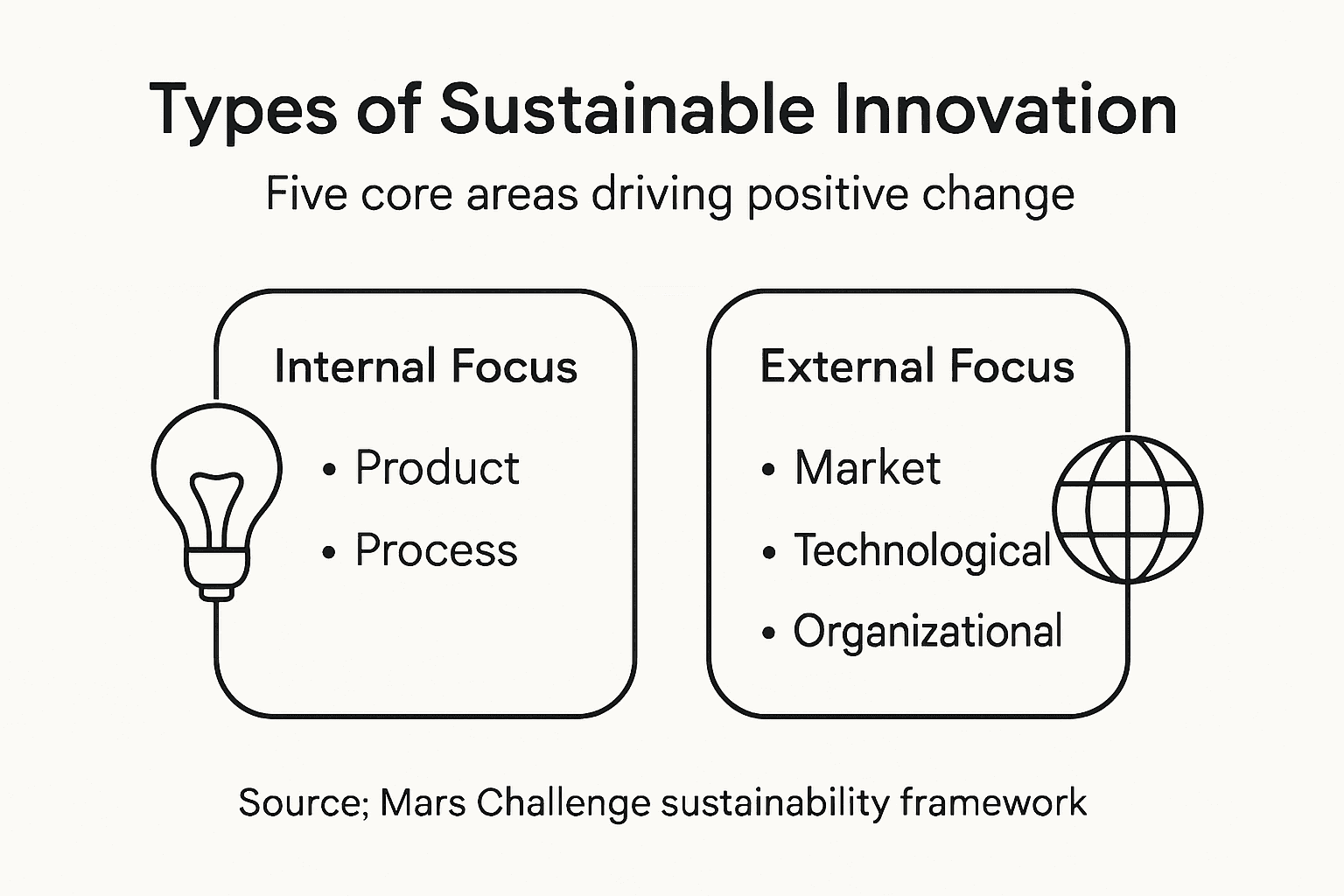
Five Core Types of Sustainable Innovation
Product innovation creates new goods or services that solve sustainability problems. Think water purification devices, plant-based materials, or apps that reduce food waste.
Process innovation changes how things are made. A factory that shifts from chemical dyes to natural alternatives is process innovation.
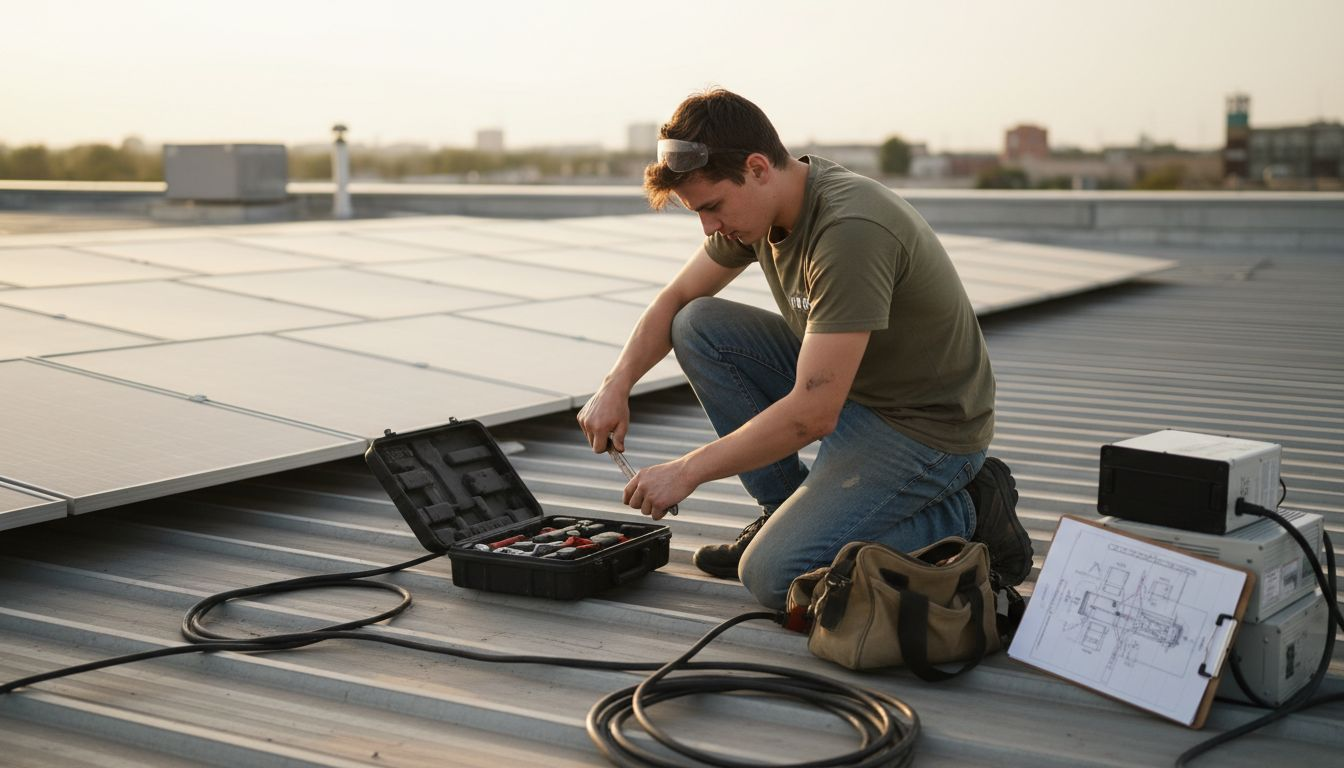
Technological innovation develops new tools and systems. Solar panels, carbon capture technology, and regenerative agriculture techniques all fit here.
Organizational innovation transforms how companies operate internally. Switching to circular economy principles or restructuring supply chains to reduce emissions counts.
Market innovation shifts how goods are bought, sold, and valued. Circular economy platforms, carbon pricing systems, and repair-focused business models reshape markets.
What Each Type Actually Accomplishes
These five types don’t work in isolation. Here’s what each uniquely delivers:
- Product innovation: Direct consumer benefits and market disruption
- Process innovation: Resource efficiency and emission reductions
- Technological innovation: Scalability and breakthrough solutions
- Organizational innovation: Systemic change within institutions
- Market innovation: Shifts how society values and exchanges resources
The most impactful solutions combine multiple innovation types—a product innovation backed by process changes and market restructuring creates cascading impact.
Consider electric vehicles. That’s product innovation (the car itself), technological innovation (battery systems), process innovation (manufacturing changes), and market innovation (charging networks and policy shifts). Each layer amplifies the others.
Why This Matters for Your Work
When you’re designing solutions in Mars Challenge challenges, you’re likely working across multiple innovation types simultaneously. Recognizing which type you’re focusing on helps you anticipate obstacles and scale faster.
A solution addressing only one type often stalls. But when you integrate product, process, and market innovations together, you create the kind of systemic change that actually reshapes how humanity operates.
Pro tip: Map your solution against all five innovation types—identify which ones you’re strong in and which ones need partnership or additional research to strengthen your overall impact.
Key Characteristics of Sustainability Innovation
Sustainable innovation isn’t just about being “green.” It has specific characteristics that separate genuine sustainability work from surface-level efforts.
Real sustainable innovation integrates three dimensions simultaneously: environmental protection, social equity, and economic viability. You can’t sacrifice one for another—they have to work together.
Core Characteristics That Define the Work
Sustainable innovation emphasizes minimizing negative impacts and promoting resource regeneration while fostering systemic change. This means thinking beyond individual products or fixes.
Key characteristics include:
- Holistic integration: Environmental, social, and economic goals coexist, not compete
- Long-term vision: Solutions account for future generations, not just immediate gains
- Systemic focus: Changes reshape entire systems, not just optimize existing ones
- Regenerative potential: Solutions actively restore resources, not just reduce harm
- Planetary boundaries: All innovations respect Earth’s actual limits
Systemic Change vs. Incremental Improvement
Here’s where many innovators get stuck. Incremental improvements make things 10-20% better. But sustainable innovation demands something different.
Transformative sustainability research emphasizes deep systemic change over incremental tweaks. This requires interdisciplinary collaboration and real engagement with the communities affected by your solutions.
Incremental: A factory uses 30% less water.
Systemic: Water management shifts from extraction to regeneration, benefiting both industry and ecosystems.
Sustainable innovation doesn’t optimize broken systems—it builds new ones aligned with how Earth actually works.
What This Looks Like in Practice
You’ll recognize sustainable innovation by these signs:
- Solutions address root causes, not just symptoms
- Multiple stakeholder groups benefit, not just consumers or corporations
- Environmental improvements don’t come at social cost
- Economic models support long-term viability, not extraction
- Solutions scale without depleting resources
When Mars Challenge teams develop solutions, they’re asking: Does this work for Earth’s life-support systems? Can it scale globally without creating new problems elsewhere?
Pro tip: Before finalizing your solution, map it against all five characteristics above—if your innovation scores low on any dimension, that’s where your next iteration should focus.
Harnessing Youth-Driven and Team-based Solutions
You bring something to sustainability work that older generations often lack: comfort with complexity, digital fluency, and the ability to see connections across disciplines. That’s not just an advantage—it’s essential.
Youth-driven approaches work because you’re not bound by “how things have always been done.” You ask different questions, challenge assumptions, and imagine possibilities that entrenched systems miss.
Why Youth Leadership Matters Now
Young innovators don’t accept false trade-offs. You won’t settle for solutions that help the environment while harming communities, or create economic growth while depleting resources. This holistic thinking is exactly what sustainability demands.
Youth engagement and collaborative team approaches combine natural and social sciences with humanities to create comprehensive solutions grounded in cultural reality.
Team-based work amplifies this advantage. Here’s why diversity in your teams matters:
- Perspective diversity: Engineers see technical solutions; artists see human experience; economists understand market shifts; ecologists understand system limits
- Cognitive diversity: Different thinking styles catch blind spots others miss
- Cultural diversity: Solutions designed by homogeneous groups often fail in other contexts
- Skill complementarity: Complex problems require multiple expertise areas working together
How Teams Actually Create Better Solutions
When Mars Challenge brings together deliberately diverse teams, something shifts. A student from Kenya approaches food security differently than one from Denmark. An engineer and a social worker see different intervention points. A 15-year-old and a 28-year-old have different risk tolerances and time horizons.
These differences aren’t obstacles. They’re assets.
Universities and research institutions empower youth through multidisciplinary teams addressing complex sustainability challenges on a global scale. The key is structured collaboration—not just putting smart people in a room together.
The most innovative solutions come from teams where members disagree respectfully, challenge each other’s assumptions, and genuinely integrate diverse expertise.
This is why Mars Challenge emphasizes Next Human Learning: teaching you to navigate paradox, work across difference, and make decisions under real constraints. These meta-skills matter more than any single technical skill.
Your Role in This Moment
You’re working at a critical inflection point. Climate science is clearer than ever. Technology is accessible. But implementation still lags—not because of ideas, but because of how institutions operate.
Your generation has permission to reimagine everything: how food systems work, how cities are designed, how energy flows, how technology serves humanity rather than extracting value.
Pro tip: In your team collaborations, explicitly map each member’s expertise and perspective at the start—then deliberately use those differences when you’re stuck, rather than defaulting to whoever speaks loudest.
Risks, Barriers, and Common Pitfalls to Avoid
Great ideas fail. Not because they’re wrong, but because innovators underestimate the obstacles ahead. Knowing what typically derails sustainable innovation projects lets you navigate around these traps.
The gap between innovation and implementation is wider than most teams realize. You can design brilliant solutions and still watch them collapse when they hit reality.
The Three Major Barriers You’ll Face
Insufficient funding, limited academic-business cooperation, and institutional rigidity hinder practical implementation of innovations. These barriers stall sustainability goals unless addressed strategically.
Understanding each helps you plan ahead:
- Funding gaps: Early-stage sustainable innovations rarely attract traditional venture capital. Impact investors move slowly. Government grants have bureaucratic timelines.
- Cooperation barriers: Universities reward publications. Companies prioritize quarterly earnings. These incentives don’t align with long-term sustainability work.
- Institutional resistance: Organizations protect existing power structures and revenue models. Your solution threatens that.
Common Pitfalls in Design and Execution
Even well-funded teams stumble. Here’s where most innovations falter:
Optimizing the wrong things. Teams focus on technical perfection while ignoring adoption barriers. Your water purification system works beautifully in the lab but costs three times what communities can afford.
Ignoring power dynamics. Solutions imposed on communities fail. Local actors feel excluded. Implementation collapses when external support disappears.
Pursuing purity over progress. Waiting for the perfect zero-impact solution means never shipping anything. Sometimes good-enough solutions that scale beat perfect solutions that don’t.
Common pitfalls involve tensions between research outputs and societal impact, alongside accountability and methodological challenges requiring post-normal science approaches.
The most dangerous assumption is that a brilliant solution will automatically spread. Distribution, adoption, and scaling are distinct problems requiring different skills.
What Mars Challenge Teams Do Differently
You’re learning to anticipate these barriers because you’re working on real constraints from day one. You’re not designing in isolation. You’re engaging stakeholders, understanding systems, and building solutions that account for political, economic, and cultural realities.
Your diverse teams catch blindspots. An engineer might miss a financial barrier a business-minded teammate catches. A local community member flags implementation challenges international designers never considered.
This table summarizes common barriers and solutions for scaling sustainable innovations:
| Barrier | Description | Practical Response |
|---|---|---|
| Funding Gaps | Slow and uncertain investment for early projects | Seek blended finance or donors |
| Academic-Business Divide | Misaligned incentives between sectors | Build cross-sector partnerships |
| Institutional Resistance | Hesitance to alter existing structures | Engage stakeholders early |
| Adoption Friction | Community reluctance, complexity barriers | Co-design with local users |
Pro tip: Build a “barrier map” early: identify funding needs, stakeholder incentives, institutional blockers, and adoption friction before you’re invested in a specific solution—this helps you pivot faster when reality demands it.
Empower Your Breakthroughs with Mars Challenge
Innovation in sustainability requires more than incremental changes. It demands holistic, systemic transformation that embraces environmental impact, social equity, and economic viability—all core themes explored in the article “Innovation in Sustainability – Empowering Next Gen Impact.” If you are driven by the need to create regenerative solutions that reimagine our planetary systems, Mars Challenge offers the ideal platform to develop these real-world innovations with diverse, collaborative teams.
Join a global community of young innovators aged 15 to 29 who are mastering the art of Next Human Learning to navigate complexity, foster ethical intelligence, and challenge outdated models. Mars Challenge equips you with the meta-skills and frameworks necessary to overcome common barriers like institutional resistance, funding gaps, and adoption friction highlighted in the article. Do not wait to be part of the movement that prototypes the future of Earth’s life-support systems today. Discover how you can accelerate your impact by visiting Mars Challenge. Learn more about the structured methodology and team-based challenges that foster sustainable innovation at Mars Challenge’s landing page and explore the global learning movement redefining the meaning of innovation at Mars Challenge. Take the first step now and transform your ideas into scalable solutions that truly matter.
Frequently Asked Questions
What is sustainable innovation?
Sustainable innovation refers to creating fundamentally different approaches to solving problems that integrate environmental impact, social responsibility, and economic viability. It involves reimagining systems rather than just making incremental changes.
How does sustainable innovation differ from green innovation?
While green innovation focuses on improving efficiency and reducing harm within existing systems, sustainable innovation seeks to transform those systems entirely. It aims for solutions that can regenerate resources and benefit communities sustainably.
What are the types of sustainable innovation?
The five core types of sustainable innovation include product innovation (new goods/services), process innovation (changes in production methods), technological innovation (new tools and systems), organizational innovation (internal company transformations), and market innovation (shifts in how goods are valued).
Why is youth involvement crucial in sustainable innovation?
Youth involvement is vital because younger generations bring comfort with complexity, challenge traditional assumptions, and are willing to ask questions that lead to holistic solutions. Their diverse perspectives and digital fluency enhance the design of sustainability projects.