


Launching an innovation challenge can feel daunting when so much hinges on getting the first step right. For educators seeking to empower youth in STEM programs, defining clear objectives and building a diverse team sets the foundation for every breakthrough ahead. By focusing on a well-structured challenge statement and inclusive team formation, you unlock creativity and align everyone toward a shared mission—driving real impact with youth-led solutions.
Table of Contents
- Step 1: Define Challenge Objectives And Team Formation
- Step 2: Design Structured Innovation Methodology
- Step 3: Implement Mentorship And Resource Support
- Step 4: Facilitate Solution Prototyping And Iteration
- Step 5: Validate Outcomes And Share Results
Quick Summary
| Key Point | Explanation |
|---|---|
| 1. Define clear challenge objectives | Craft a focused statement that outlines the problem, who it affects, and the impact it could create. |
| 2. Build a diverse innovation team | Gather individuals with varied skills and perspectives to enhance creativity and problem-solving capacity. |
| 3. Design a structured innovation process | Use key phases—definition, ideation, prototyping, testing—to guide teams while allowing for flexibility. |
| 4. Facilitate ongoing mentorship | Regularly connect teams with mentors to support development and provide guidance on challenges encountered. |
| 5. Validate and share your outcomes | Establish clear success criteria, gather user feedback, and share results to demonstrate impact and enhance visibility. |
Step 1: Define challenge objectives and team formation
Defining your challenge objectives sets the direction for everything that follows. A clear, focused challenge statement helps your team stay aligned and motivated throughout the innovation process.
Start by crafting a clear challenge statement that describes the problem without suggesting solutions. Your statement should identify who the challenge affects, what the specific problem is, and why it matters. Avoid including potential solutions at this stage—that’s where creativity comes in later.
Consider these elements when writing your challenge:
- The specific problem your team will address
- Who experiences this problem and why they care
- The constraints or conditions the solution must work within
- The impact your solution could create
Once your objectives are solid, focus on building your team. Effective team formation involves gathering people with different backgrounds, skills, and perspectives. Include voices from those who will actually use the solution—they bring invaluable real-world insights.
For youth-centered challenges, meaningful youth participation matters from day one. Give young team members real decision-making power, not just tasks. Help them understand how their role connects to the challenge objectives.
Diverse teams solve complex problems better than homogeneous ones—intentionally build for different perspectives, not just different backgrounds.
Think about diversity in multiple dimensions:
- Skills: engineers, designers, communicators, strategists
- Experience: people from different industries or communities
- Background: gender, culture, socioeconomic context, ability
- Thinking style: analytical minds paired with creative thinkers
Set team size based on your challenge complexity—typically four to eight people works well for youth innovation teams. Larger groups need more facilitation; smaller teams may lack perspective diversity.
Here’s a helpful summary of youth innovation team diversity dimensions and their benefits:
| Dimension | Examples | Value for Innovation |
|---|---|---|
| Skills | Engineers, designers, strategists | Enables broad solution design |
| Experience | Different industries, communities | Provides varied perspectives |
| Background | Gender, culture, abilities | Enhances inclusivity and reach |
| Thinking Style | Analytical, creative, pragmatic | Fosters balanced team decisions |
Pro tip: Have each team member explain why they joined and what unique perspective they bring before you start ideating—this builds psychological safety and helps everyone see each other’s strengths from the beginning.
Step 2: Design structured innovation methodology
A structured methodology transforms innovation from a chaotic brainstorm into a purposeful journey. Your process should guide teams through clear phases while remaining flexible enough to revisit earlier stages when new insights emerge.
A structured innovation approach typically breaks into key phases: challenge definition, ideation, prototyping, and testing. Each phase builds on the previous one, but don’t treat it as purely linear. Real innovation requires circling back when you discover something important.
Your methodology should include:
- Challenge definition where you refine the problem statement
- Ideation sessions that generate multiple potential solutions
- Prototyping to build quick, testable versions
- Testing and feedback cycles that inform iterations
- Reflection points to reassess your direction
Within each phase, provide your team with specific tools and checklists. Tools keep teams focused and prevent scope creep. Checklists ensure you don’t skip critical thinking steps.
For youth teams especially, build in regular progress checkpoints. These aren’t about judgment—they’re about measuring what you’ve learned and what adjustments you need to make. A checkpoint might ask: What problem are we actually solving? Is our solution addressing the real need? What assumptions have we tested?
Flexibility within structure is the secret: rigid processes stifle creativity, but no process at all creates chaos.
Design your timeline realistically. Youth teams often have limited time, so break the challenge into achievable milestones. If your full challenge runs eight weeks, maybe ideation takes two weeks, prototyping takes three, and testing takes two. The final week allows for refinement and presentation preparation.
Communicate your methodology clearly to your teams at the start. Everyone should understand the phases, the tools available at each stage, and how long each phase typically takes. This shared understanding prevents frustration and keeps momentum high.
To clarify the innovation process, here’s a breakdown of key phases, their purpose, and common tools used:
| Phase | Main Purpose | Common Tools |
|---|---|---|
| Challenge Definition | Refine problem statement | Problem framing canvas |
| Ideation | Generate solution ideas | Brainstorm, mind mapping |
| Prototyping | Build testable models | Mockups, 3D tools |
| Testing/Feedback | Gather user insights | Surveys, interviews |
| Reflection | Review direction | Team check-ins, journals |
Pro tip: Create a visible timeline or roadmap that your team can see throughout the challenge—post it in your workspace or share it digitally so everyone knows exactly where they are in the process and what comes next.
Step 3: Implement mentorship and resource support
Mentorship and resources are the backbone of youth innovation success. Without them, even the most talented teams struggle to navigate complexity, access tools, or sustain momentum through challenges.

Start by identifying mentors who bring diverse expertise. You need people who can guide on technical skills, creative thinking, business viability, and ethical considerations. Mentors don’t need to be industry titans—experienced professionals, university faculty, or practitioners from your community work equally well.
Personalized coaching builds leadership skills alongside technical knowledge. Structure mentorship as regular check-ins, not occasional drop-by sessions. Monthly or bi-weekly meetings give mentors enough insight to provide meaningful guidance.
Clarify mentor roles upfront. Are they sounding boards for ideas? Do they review prototypes? Will they help teams navigate stakeholder conversations? Different mentors might have different focuses, and that’s fine—just make expectations clear.
Your support system should address:
- Access to funds for materials, prototyping, travel, or expert consultations
- Technical resources like lab space, software licenses, or equipment
- Domain expertise through mentor networks or guest speakers
- Safety nets that help teams persist through setbacks
Removing resource barriers doesn’t just help teams succeed—it signals that you believe in their potential and are invested in their growth.
Budget realistically. Youth teams prototyping solutions need actual resources, not just enthusiasm. If your challenge involves hardware, factor in component costs. If it’s digital, consider software subscriptions or cloud computing credits.
Create accessible pathways to support. Teams shouldn’t have to jump through bureaucratic hoops to get help. A simple form, email address, or regular office hours works better than complex application processes. Youth teams are more likely to ask for help if the process feels straightforward.
Build in mechanisms to sustain engagement over time. This might mean celebrating small milestones, connecting teams with peer support groups, or providing mental health resources alongside technical ones.
Pro tip: Match each team with one primary mentor early and have them attend the first team meeting—this relationship investment pays dividends in team confidence and follow-through when challenges get tough.
Step 4: Facilitate solution prototyping and iteration
Prototyping transforms abstract ideas into tangible things you can test and learn from. This phase is where youth teams move from talking about solutions to actually building and refining them based on real-world feedback.
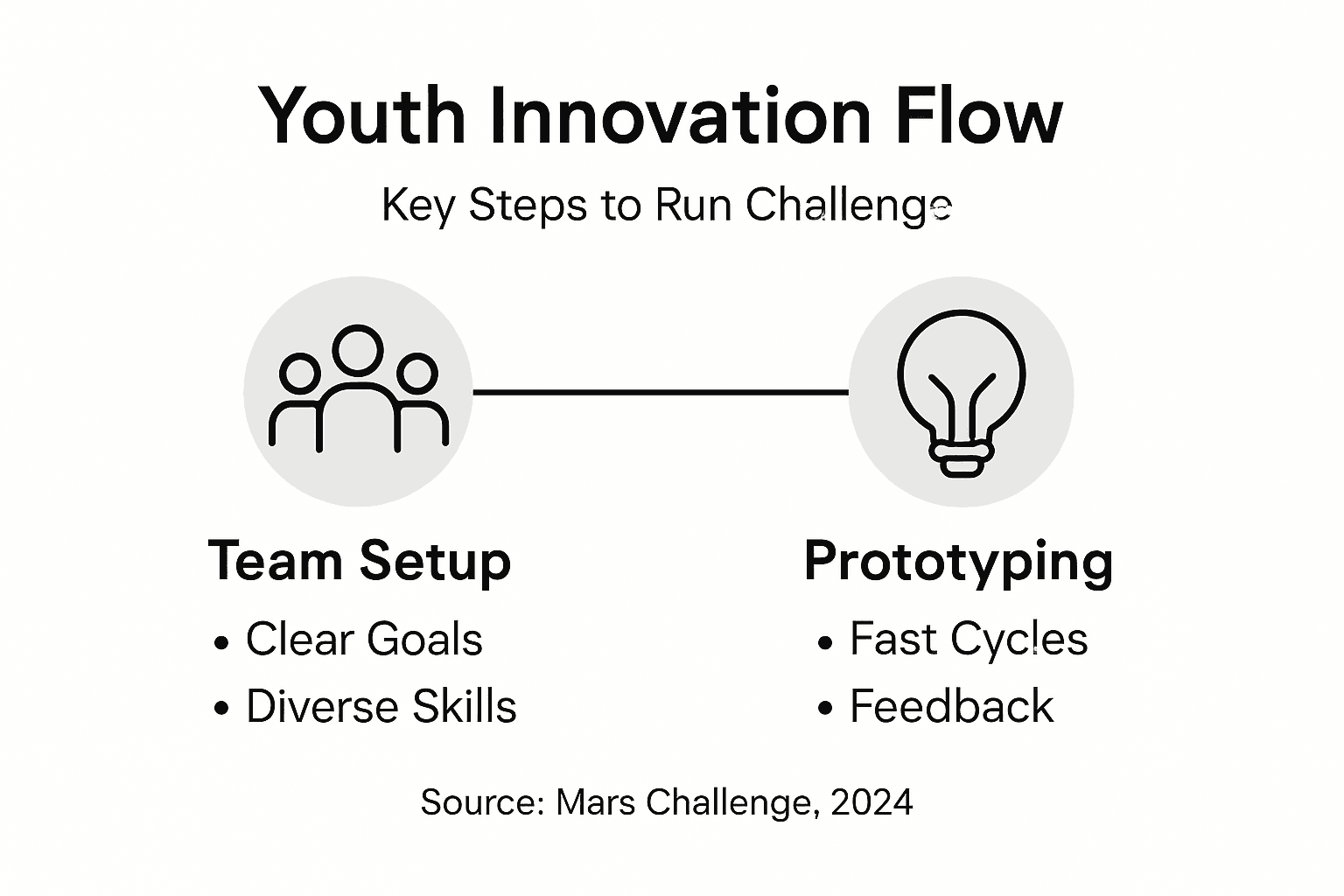
Rapid prototyping cycles allow teams to test ideas quickly and discover what works before investing in full development. A prototype doesn’t need to be polished—it needs to reveal what you’re missing. Early prototypes are often rough, low-fidelity versions that spark learning and conversation.
Encourage an experimental mindset where failure is expected and valued. When teams view prototypes as learning tools rather than final products, they take more creative risks. Frame each iteration as a chance to answer specific questions: Does this solve the problem? Will users actually adopt it? What assumptions were wrong?
Structure your iteration cycles clearly:
- Build a simple prototype addressing one core challenge
- Test it with real users or stakeholders
- Gather specific feedback on what works and what doesn’t
- Document what you learned
- Refine based on evidence, then repeat
In the Act phase, teams develop and test evidence-based solutions through multiple iterations. Each cycle should take days or weeks, not months. Speed matters because quick cycles help teams fail forward and learn faster.
Provide teams with prototyping tools and environments. This might mean makerspace access, 3D printers, software platforms, or simply a dedicated workspace with supplies. Remove obstacles so teams can focus on creation and learning.
The best prototype is the one that teaches you something you didn’t know before—not the one that looks prettiest.
Document each iteration systematically. Have teams record what they tested, what feedback they received, and what they changed as a result. This documentation shows growth, prevents repeating mistakes, and helps teams articulate their learning journey.
Schedule regular review sessions where teams present prototypes to mentors, peers, or potential users. External perspectives reveal blind spots and spark new ideas. These sessions also keep teams accountable and motivated.
Pro tip: Set a strict “prototype budget” for each iteration—a specific number of days or resources—to prevent teams from getting stuck perfecting early-stage versions instead of moving through multiple learning cycles.
Step 5: Validate outcomes and share results
Validation transforms team efforts into credible evidence of impact. This step ensures your solutions actually work and creates a foundation for scaling innovations beyond the challenge.
Start by defining clear success criteria before teams finish their work. Success criteria answer questions like: How will we know if this solution works? What metrics matter most? How will we measure impact on actual users? Criteria should be specific, measurable, and tied to your original challenge objectives.
Assessing solutions against defined criteria determines effectiveness and scalability. Have teams test their solutions with real users or stakeholders, not just mentors. Gather quantitative data where possible—how many people benefited, what costs were reduced, what time was saved. Equally important is qualitative feedback—what did users actually think and feel?
Create a structured evaluation process:
- Impact potential: Does this solution address the core problem at scale?
- Feasibility: Can it realistically be implemented with available resources?
- Sustainability: Will it keep working without constant external support?
- User adoption: Would people actually use this solution?
- Innovation: Does it offer a novel approach or significant improvement?
Public showcases and reports help build communities of practice around innovations. Sharing results amplifies learning across your network and enables others to build on what your teams discovered.
Plan your results-sharing strategy early. This might include presentations at school assemblies, reports for stakeholders, social media documentation, or participation in broader innovation conferences. Young innovators deserve visibility for their work.
Sharing isn’t just about celebration—it’s about accountability and contribution to a larger movement.
Document thoroughly throughout the challenge, not just at the end. Have teams maintain records of their process, decisions, learning moments, and failures. This documentation supports storytelling and helps others replicate or improve upon the approach.
Create multiple formats for sharing results. Some stakeholders want executive summaries, others want detailed technical reports, and younger audiences respond to videos or social media content. Meeting people where they are increases your reach and impact.
Pro tip: Have teams create a one-page impact summary highlighting their challenge, solution, validation results, and next steps—this makes it easy for stakeholders to quickly understand what was achieved and why it matters.
Empower Youth Teams to Innovate with Purpose and Impact
The vital steps of defining clear challenge objectives, building diverse teams, and applying a structured innovation methodology can feel overwhelming for youth-led groups aiming to create real-world solutions. Key concepts like meaningful youth participation, rapid prototyping, and iterative testing demand not only guidance but also resources and mentorship. For teams passionate about solving urgent challenges ranging from climate change to sustainable cities, having a proven framework and supportive community makes all the difference.
At Mars Challenge, we empower young innovators ages 15 to 29 to engage in high-impact, team-based challenges that cultivate critical skills such as ethical intelligence and collective innovation. By joining our global platform, youth teams gain access to the very structured processes and mentorship needed to bring ideas from concept to tested prototype. Our program embodies the principles highlighted in the article by blending challenge definition, iteration cycles, and real outcome validation within a supportive, diverse environment.
Take the first step to transform your youth innovation challenge into a powerful movement with Mars Challenge. Discover how you can build resilient, creative teams ready to tackle humanity’s biggest problems today at Mars Challenge Why It Matters.
Join the next generation of problem solvers shaping our shared future. Explore How to Run Innovation Challenge for Youth Teams in practice by visiting our website and learn how to launch your team’s journey from idea to impact now.
Frequently Asked Questions
How do I define challenge objectives for an innovation challenge for youth teams?
Start by crafting a clear challenge statement that specifically describes the problem and identifies who is affected. Outline the constraints and potential impacts of the solution to ensure alignment and focus throughout the challenge.
What steps should I take to build an effective team for the innovation challenge?
Gather a diverse group of individuals with various skills and experiences, including those affected by the problem. Aim for a team size of four to eight members to maintain effective collaboration while ensuring a range of perspectives.
How can I design a structured methodology for the innovation process?
Create a phased approach that includes challenge definition, ideation, prototyping, testing, and reflection. Be prepared to revisit earlier stages based on new insights, while providing your team with specific tools and checklists to stay on track.
What resources do youth teams need to effectively prototype their solutions?
Ensure teams have access to necessary materials, technical resources, and mentorship throughout the prototyping phase. Encourage an experimental mindset, allowing teams to create and iterate on early prototypes based on real-world feedback.
How do I measure the success of the innovation challenge outcomes?
Define clear success criteria before starting the challenge to assess the effectiveness of solutions. Evaluate prototypes with real users to gather both quantitative metrics and qualitative feedback, and ensure the results are documented for sharing.
What is the best way to share results from the innovation challenge?
Plan a results-sharing strategy that includes presentations, reports, and social media content. Highlight the impact and learning outcomes in a concise one-page summary to effectively communicate the project’s significance to stakeholders.