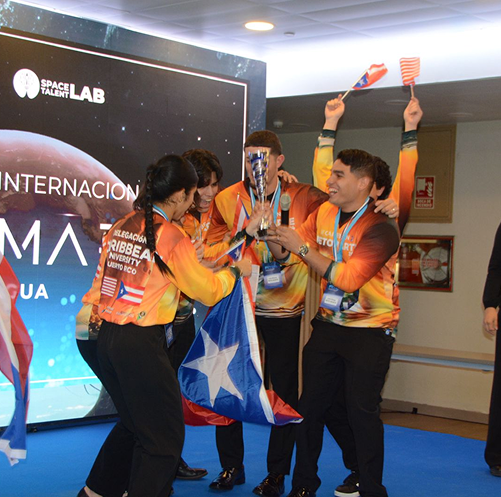


Every institution faces the challenge of preparing students for a rapidly changing world. Building truly diverse student teams unlocks breakthrough thinking, especially when each member connects to a shared mission. By combining perspectives from different regions, disciplines, and backgrounds, educational leaders can create powerful frameworks that drive innovation and real impact. This article explores strategies for assembling purpose-driven teams, setting clear objectives, and guiding collaborative solution development for global sustainability challenges.
Table of Contents
- Step 1: Assemble Diverse And Purpose-Driven Teams
- Step 2: Define Challenge Objectives And Criteria
- Step 3: Facilitate Collaborative Problem-Solving Sessions
- Step 4: Implement And Monitor Solution Development
- Step 5: Evaluate And Validate Team Outcomes
Quick Summary
| Key Takeaway | Explanation |
|---|---|
| 1. Construct diverse teams | Diverse teams foster innovation by bringing together different perspectives, backgrounds, and experiences. |
| 2. Define clear objectives | Concrete, measurable goals provide direction and help assess progress, ensuring alignment across the team. |
| 3. Facilitate inclusive sessions | Structured problem-solving meetings create an environment where every voice is valued, leading to better solutions. |
| 4. Monitor implementation closely | Regular check-ins and clear work plans keep team members accountable and focused on deliverables. |
| 5. Evaluate outcomes thoroughly | Honest assessment of both team performance and solution effectiveness ensures lessons are learned and future improvements are made. |
Step 1: Assemble diverse and purpose-driven teams
Your team’s composition determines its capacity to solve complex problems. Building deliberately diverse groups isn’t just morally right—it’s strategically essential for innovation and breakthrough thinking.
Start by defining what “diverse” means for your specific challenge. Look beyond surface-level differences. You need cognitive diversity, professional backgrounds, geographic perspectives, and lived experiences that genuinely differ from one another.
When building diverse global teams, prioritize these dimensions:
- Geographic distribution: Include participants from different regions and countries to capture varied cultural perspectives
- Professional backgrounds: Mix students from science, design, business, humanities, and engineering disciplines
- Age and experience levels: Combine newcomers with those who’ve tackled challenges before
- Learning styles: Include visual thinkers, analytical minds, and hands-on learners
- Socioeconomic contexts: Ensure representation across different economic realities and opportunities
Now, connect diversity to purpose. Your team needs a shared mission that transcends individual goals. This is where alignment happens. According to research on leading global teams with purpose, authenticity, and trust, a clear and shared purpose drives long-term success and enables teams to work toward meaningful impact.
Make the purpose explicit during team formation. Don’t assume everyone understands why they’re working together. Have conversations about what success means, what impact you’re seeking, and how each person’s unique perspective strengthens the group’s ability to achieve it.
Diverse teams outperform homogeneous ones—but only when they share genuine purpose and trust, not just demographic variety.
Be intentional about team size. Smaller teams move faster; larger ones bring more perspectives. For Mars Challenge work, aim for 4 to 8 people. This is small enough to communicate clearly but large enough to avoid echo chambers.
Here’s a comparison of global team sizes and their typical advantages and challenges:
| Team Size | Common Benefits | Potential Drawbacks |
|---|---|---|
| 4-5 Members | Fast decision-making | Risk of limited viewpoints |
| 6-8 Members | Diverse perspectives | Slower consensus-building |
| 9+ Members | Increased expertise | Communication complexity |
Selecting the right size balances efficiency and diversity.
Pro tip: During your first team meeting, have each member share one thing they’re genuinely concerned about solving in the world—not just their role on the team. This personal connection to purpose creates the psychological safety needed for diverse voices to speak up later.
Step 2: Define challenge objectives and criteria
Clear objectives transform vague ideas into actionable targets. Without them, your global team will lack direction and struggle to measure progress.
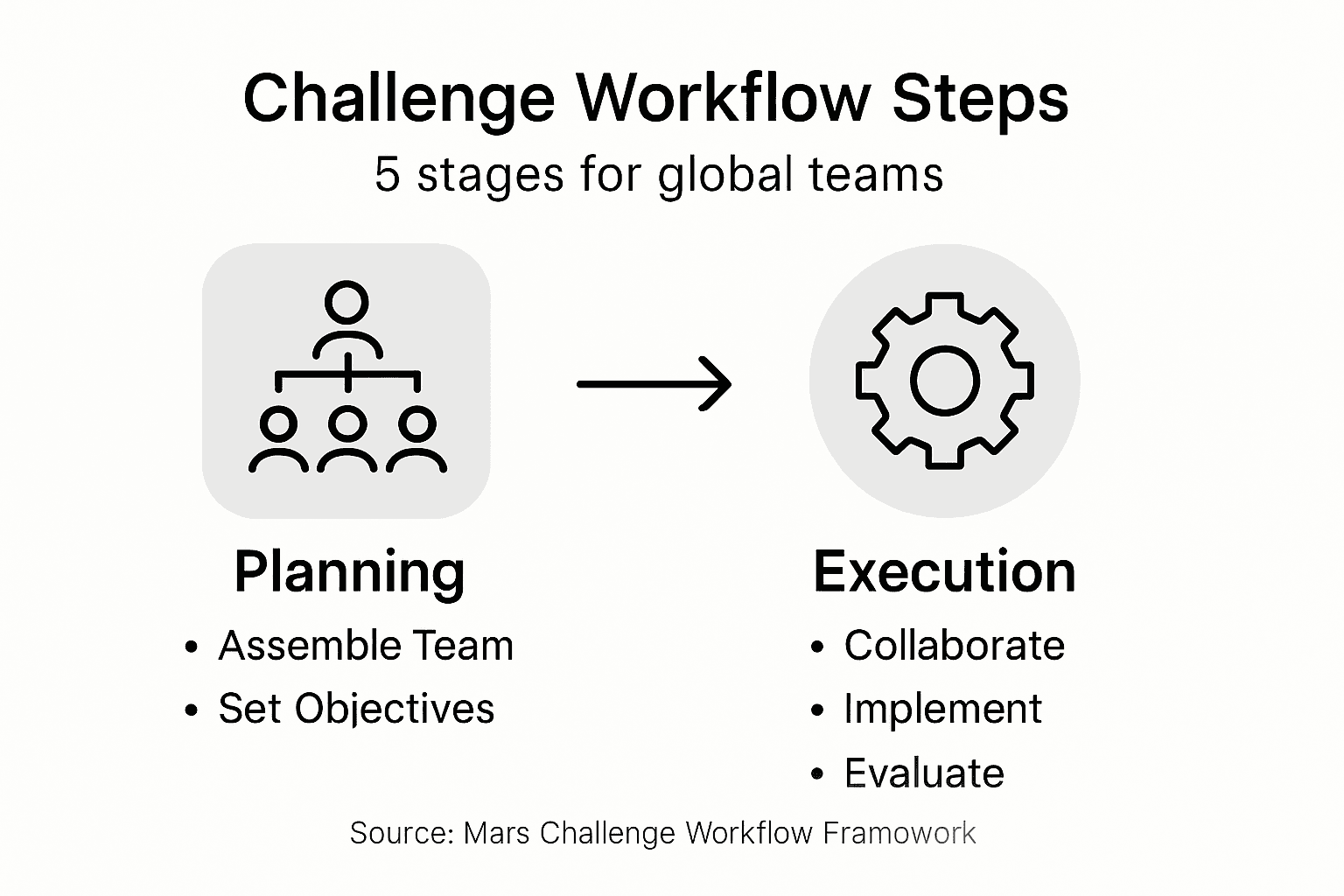
Start by articulating what your challenge actually aims to solve. This isn’t a vague mission statement—it’s a concrete description of the problem your team will tackle. For Mars Challenge participants, this might mean reimagining food systems resilience, designing circular cities, or solving energy access in remote communities.
Objectives should be quantifiable and measurable. Rather than “improve sustainability,” aim for specifics like “reduce water consumption by 40% in urban agriculture” or “design a scalable energy solution for communities lacking grid access.” Measurable targets help distributed teams stay aligned across time zones and cultural contexts.
Next, establish evaluation criteria that will guide your work. Using evaluation frameworks like relevance, coherence, effectiveness, efficiency, impact, and sustainability ensures your challenge remains focused on what truly matters.
Consider these dimensions as you build your criteria:
- Relevance: Does your objective address real-world problems?
- Coherence: Do all team efforts align with the core challenge?
- Effectiveness: Will your solution actually achieve the stated objective?
- Efficiency: Can it be delivered within available time and resources?
- Impact: What long-term change will it create?
- Sustainability: Can the solution endure beyond the challenge period?
Balancing scope, time, cost, and quality matters intensely for geographically dispersed teams. Define what success looks like in concrete terms that everyone can understand, regardless of language or background.
Vague objectives breed confusion; precise ones create momentum across global teams.
Document your objectives and criteria in a shared space your team can access constantly. This becomes your north star whenever decisions get difficult.
Pro tip: Have your team validate objectives together during week one, then revisit them monthly to ensure they still reflect the challenge’s evolving understanding and real-world constraints.
Step 3: Facilitate collaborative problem-solving sessions
Structured sessions turn scattered ideas into focused solutions. Your role as a facilitator is to guide conversations, ensure everyone’s voice matters, and keep the team moving toward actionable outcomes.
Start by creating psychological safety. Team members won’t contribute boldly if they fear judgment or dismissal. Set clear norms at the beginning: all ideas deserve consideration, criticism targets ideas not people, and silence means agreement isn’t required.
Define the problem statement together before diving into solutions. Spend time ensuring everyone understands what you’re actually solving. This alignment prevents wasted effort and reduces friction across time zones and cultural contexts.
When facilitating collaborative problem-solving, use structured techniques that keep discussions focused and inclusive. Brainstorming generates volume; SWOT analysis examines feasibility; affinity mapping organizes chaos into patterns.
Here’s a practical sequence for your sessions:
- Define the problem together in clear, observable terms
- Generate ideas without judgment, quantity over quality at first
- Evaluate options using your established criteria and objectives
- Select promising directions that multiple team members can champion
- Assign ownership so someone drives each next step
Leverage diverse expertise across global teams to strengthen solutions. Someone’s cultural background, professional training, or life experience will reveal blind spots others missed. Actively invite different perspectives rather than waiting for them to emerge.
Use digital tools that work across time zones. Shared documents, asynchronous brainstorming, and recorded sessions ensure no one gets left behind by scheduling constraints.
Great solutions come from diverse minds being heard equally, not from the loudest voice dominating the room.
End every session with clarity. What was decided? Who does what next? When do we reconvene? Ambiguity breeds frustration in distributed teams.
Pro tip: Rotate facilitation roles across team members after your first session, so people develop leadership skills and feel ownership over the process, not just the outcomes.
Step 4: Implement and monitor solution development
Ideas mean nothing without execution. This step transforms your team’s concepts into tangible prototypes and working solutions while keeping everyone accountable across distances and time zones.

Begin by creating a project charter that outlines what you’re building, who owns each part, and what success looks like. Document this clearly so team members in different regions understand their responsibilities without constant clarification.
Break your solution into manageable tasks with realistic deadlines. Large ambitions fail when teams don’t know where to start. Assign specific people to specific tasks, then trust them to own their work.
When managing solution implementation in global teams, establish clear work plans and success metrics from day one. Vague progress leads to missed deadlines and frustration. Define what “done” looks like for each component.
Track progress using these essential monitoring practices:
- Weekly check-ins: Brief, focused updates on what’s complete and what’s blocked
- Key performance indicators: Measurable metrics tied to your original objectives
- Risk logs: Document obstacles early so the team can problem-solve together
- Prototype iterations: Regular cycles of building, testing, and refining
- Cross-functional reviews: Ensure different specializations stay connected
Adapt your leadership style to what each team member needs. Some people thrive with autonomy; others need more coaching and structure. Check in individually, not just in group settings.
Maintain transparent communication about delays and challenges. Hidden problems explode later. When something isn’t working, surface it immediately and adjust your plan rather than pretending progress is on track.
Implementation reveals what planning missed. Stay flexible while remaining focused on your core objectives.
Celebrate milestones visibly. When your team completes a prototype, tests a hypothesis, or solves a major technical problem, acknowledge it. Distributed teams need those moments of collective achievement.
Pro tip: Use asynchronous documentation for everything—recorded demos, written updates, shared decision logs—so team members across time zones can stay informed without requiring simultaneous meetings.
Step 5: Evaluate and validate team outcomes
Evaluation separates real impact from perceived progress. This step ensures your team’s solution actually solves the problem you defined and that every member contributed meaningfully to the work.
Start by measuring outcomes against your original objectives. Did you reduce water consumption by the target percentage? Did your solution reach the intended communities? Numbers don’t lie, and they provide clarity that opinions cannot.
Assess both the solution quality and the team process separately. A brilliant outcome developed through dysfunction teaches nothing for future challenges. Conversely, perfect collaboration on a weak solution wastes potential.
When evaluating global and virtual team outcomes, examine team identification, motivation, and collaboration dynamics. Did members feel part of something meaningful? Were they genuinely motivated to contribute, or merely going through motions? These dimensions reveal whether your team structure actually worked.
Implement these evaluation methods:
- Peer assessments: Team members evaluate each other’s contributions honestly and constructively
- Solution testing: Validate your prototype against real-world conditions and user feedback
- Process reflection: Ask what worked, what failed, and why
- Individual growth tracking: Did people develop new skills or perspectives?
- Impact documentation: Measure tangible outcomes tied to your challenge objectives
Peer assessments foster accountability and provide insights into collaboration quality. They’re uncomfortable conversations, but essential ones. People need honest feedback about their contributions and behavior.
To help clarify team evaluation, here’s a summary of useful outcome assessment approaches:
| Method | Team Focus | Outcome Focus |
|---|---|---|
| Peer Assessment | Checks collaboration quality | Highlights individual contributions |
| Prototype Testing | Reveals real-world impact | Documents tangible results |
| Process Reflection | Identifies team strengths | Tracks growth and learning |
Combining these methods ensures both product and teamwork are fully evaluated.
Create a safe space for this evaluation. Frame it as learning, not judgment. Distributed teams especially need structured feedback mechanisms since informal conversations happen less naturally across time zones.
Evaluation without honesty is just celebration. Harsh evaluation without support is just criticism. Balance both.
Document your findings thoroughly. What will you do differently next time? What should other teams know? This knowledge compounds across your institution as more teams run challenges.
Pro tip: Have team members write anonymous reflections first, then discuss them together—this reduces social pressure and surfaces honest perspectives that might stay hidden in group settings.
Unlock the Power of Structured Global Teamwork with Mars Challenge
The article highlights the challenges global teams face in building diverse, purpose-driven groups and maintaining clear objectives while navigating complex problem-solving across time zones and cultures. If you struggle with aligning your team’s shared mission, managing distributed collaboration, or turning ideas into impactful solutions, these are pain points Mars Challenge expertly addresses. Our program is designed to cultivate exactly the skills and frameworks discussed, including intentional diversity, clear measurable goals, psychological safety, and transparent evaluation.
Mars Challenge empowers young innovators worldwide to participate in high-impact, team-based challenges applying a structured methodology called Next Human Learning. By joining, you gain access to a proven workflow that transforms scattered ideas into cohesive solutions with real-world impact. Learn more about how to build and lead global teams that thrive under complexity and uncertainty by exploring the Mars Challenge platform.
Experience firsthand how deliberate diversity and purpose-driven collaboration fuel breakthrough innovation. Don’t wait for global challenges to overwhelm your team. Take the next step today and become part of a transformative movement reimagining the future of life on Earth and Mars at Mars Challenge. Start shaping your team’s success and impact now.
Frequently Asked Questions
How do I assemble a diverse team for global challenges?
Building a diverse team involves selecting members with varying geographic backgrounds, professional experiences, and cognitive styles. Aim to include individuals from different regions and disciplines to enhance creativity. Start by identifying specific diversity dimensions relevant to your challenge, such as age, socioeconomic contexts, and learning styles.
What are the best practices for defining challenge objectives?
To define challenge objectives, articulate a concrete problem statement that outlines what you aim to address. Set quantifiable and measurable goals, such as reducing resource use by a specific percentage, to ensure team alignment and progress tracking. Document these objectives in a shared space for easy access by all team members.
How should I facilitate collaborative problem-solving sessions?
Facilitate structured sessions by creating a psychologically safe environment where all team members feel comfortable sharing ideas. Use techniques like brainstorming and SWOT analysis to focus discussions. Guide the team through defining the problem, generating solutions, evaluating options, and assigning ownership of tasks.
What steps are involved in implementing a solution within a global team?
Implementing a solution requires creating a clear project charter that outlines tasks and responsibilities. Break the project into manageable components with specific deadlines, and establish regular check-ins to monitor progress. Maintain transparent communication about any challenges or changes in the project plan to ensure accountability.
How can I evaluate and validate the outcomes of my team’s work?
Evaluate outcomes by measuring the results against your established objectives, focusing on both solution quality and team process. Utilize methods like peer assessments, solution testing, and process reflection to gather insights into contributions and collaboration dynamics. Document findings to inform future projects and enhance team learning.