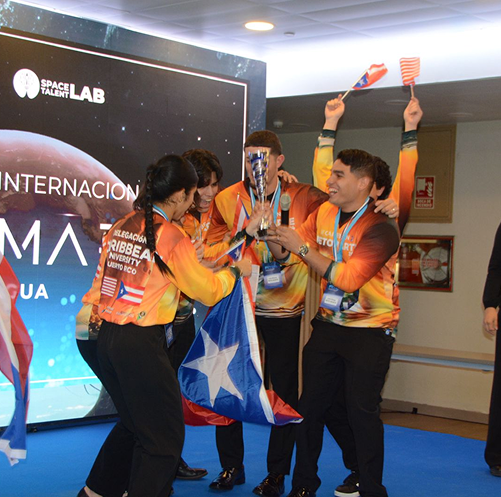


Student engagement influences academic success as powerfully as quality instruction itself. Research reveals that engagement accounts for nearly half of variation in learning outcomes, yet many institutions struggle to maintain student motivation. Sustainable innovation offers a proven pathway to address this challenge by connecting classroom learning to urgent real-world problems that matter to students, driving motivation through meaningful purpose and practical application.
Table of Contents
- Why Sustainable Innovation Matters For Student Engagement
- Mechanisms Linking Sustainable Innovation To Student Learning Outcomes
- Common Misconceptions About Sustainability Education
- Frameworks To Guide Curriculum Development For Sustainability
- Bridging Sustainable Innovation To Practical Education Applications
- Conclusion: Transforming Education With Sustainable Innovation
- Empower Your Educational Innovation With Mars Challenge
- Frequently Asked Questions
Key takeaways
| Point | Details |
|---|---|
| Engagement equals instruction impact | Student engagement affects academic success as much as teaching quality, making it a critical priority for education leaders. |
| Real-world relevance drives motivation | Linking learning to sustainability challenges increases student agency and commitment by up to 30%. |
| Skills for the AI era | Sustainability education develops critical thinking, ethical intelligence, and collaboration needed for future challenges. |
| Frameworks enable transformation | Structured models like SHE-IMM guide institutions through progressive curriculum innovation stages. |
| Practical integration is achievable | Interdisciplinary, project-based approaches make sustainability accessible across all subjects and contexts. |
Why sustainable innovation matters for student engagement
The connection between engagement and academic achievement runs deeper than most educators realize. Student engagement is central to academic success and can be enhanced through curriculum relevance and motivation tied to real-world challenges like sustainability. When students see how their learning applies to pressing environmental and social issues, their investment in education transforms fundamentally.
Sustainability creates this bridge naturally. Unlike abstract academic exercises, environmental and social challenges feel urgent and personal to today’s students. Sustainability education increases student motivation and agency in ecological and social contexts, improving learning and real-world problem-solving abilities. This relevance translates directly into measurable outcomes.
The mechanisms driving this improvement are straightforward. Sustainability topics naturally integrate multiple disciplines, requiring students to apply knowledge from science, social studies, economics, and ethics simultaneously. This interdisciplinary approach mirrors how professionals actually solve complex problems, preparing students for real careers while making learning more dynamic and engaging.
Practical examples demonstrate the magnitude of potential gains. Schools implementing sustainability-infused curricula report engagement increases of up to 30% compared to traditional approaches. Students exhibit higher attendance, deeper participation in discussions, and greater persistence when facing challenging concepts.
Pro Tip: Start small by identifying one existing unit in your curriculum that naturally connects to sustainability themes, then expand the real-world application components gradually rather than attempting a complete overhaul.
The innovation in sustainability approach works because it gives students agency. Rather than positioning them as passive recipients of information about environmental problems, it empowers them as active problem solvers developing tangible solutions. This shift from consumer to creator fundamentally alters the student-learning relationship.
Mechanisms linking sustainable innovation to student learning outcomes
Education for Sustainable Development promotes analytical thinking, ethical values, and problem-solving skills essential for addressing global sustainability challenges. These cognitive benefits extend far beyond environmental literacy, shaping how students approach any complex problem requiring systems thinking and ethical reasoning.
The educational mechanisms at work include:
- Critical thinking development: Sustainability challenges lack simple answers, requiring students to analyze multiple perspectives, evaluate trade-offs, and synthesize information from diverse sources.
- Ethical reasoning practice: Environmental and social issues inherently involve values and competing interests, providing authentic contexts for developing moral reasoning skills.
- Interdisciplinary integration: Real sustainability problems span traditional subject boundaries, teaching students to draw on multiple knowledge domains simultaneously.
- Collaborative skill building: Complex challenges require teamwork, negotiation, and collective problem-solving rather than individual competition.
- Emotional engagement: Personal connection to planetary health and community wellbeing activates deeper motivation than purely academic goals.
Institutions embedding sustainability through innovative pedagogies demonstrate improved student ecological citizenship and emotional engagement. This emotional dimension matters because sustained effort on difficult learning tasks requires more than intellectual interest alone.
Project-based learning centered on sustainability creates natural opportunities for students to experience authentic research, prototyping, and iteration cycles. These experiences build resilience and adaptability while demonstrating that failure serves as a learning tool rather than a final judgment.

The competencies developed through sustainability pedagogy strategies align precisely with workforce needs in an AI-augmented economy. As automation handles routine tasks, uniquely human capabilities like ethical judgment, creative problem-solving, and collaborative innovation become increasingly valuable.
Pro Tip: Design sustainability projects that require students to interview community members or stakeholders, building communication skills while grounding abstract concepts in lived experiences.
Common misconceptions about sustainability education
Several persistent myths prevent institutions from embracing sustainability education fully. There is a misconception that sustainability education is purely theoretical and lacks practical impact; evidence shows it develops vital human skills including judgment, communication, and teamwork. These capabilities represent exactly what students need to thrive in careers where AI handles technical execution.
Key misconceptions include:
- Myth: Sustainability is only for science classes: Reality shows sustainability concepts enrich humanities, arts, social sciences, and business curricula equally through ethical, cultural, and economic dimensions.
- Myth: Integration requires massive resources: Effective sustainability education often starts with reframing existing content rather than creating entirely new courses.
- Myth: Students lack interest: Youth consistently rank environmental and social issues among their top concerns, making this content inherently engaging.
- Myth: Implementation is straightforward: Curricular innovation integrating sustainability encounters institutional inertia, fragmented policies, and resistance to change.
The final myth deserves particular attention. While sustainability education offers clear benefits, implementation faces real obstacles. Traditional disciplinary silos resist interdisciplinary approaches. Assessment systems reward discrete knowledge over integrated competencies. Professional development often fails to equip teachers with confidence in sustainability pedagogy.
Recognizing these barriers honestly allows leaders to plan realistic transformation strategies. Success requires more than curriculum documents; it demands changes in institutional culture, teacher preparation, and organizational structures.
Pro Tip: Address resistance by highlighting how sustainability themes already appear in your existing standards and learning objectives, framing integration as enhancement rather than replacement.
Exploring types of education innovation helps identify which approaches fit your institutional context and capacity. Not every school needs identical sustainability programs; effective integration respects local culture, resources, and priorities.
Frameworks to guide curriculum development for sustainability
Structured frameworks help institutions assess current practices and plan progressive enhancement. Sustainability education frameworks like SHE-IMM provide structured approaches to assess readiness and guide curriculum transformation in stages. This maturity model identifies three institutional levels: foundational, transitional, and transformative.
The framework dimensions include:
- Curriculum integration: From isolated sustainability topics to fully integrated interdisciplinary approaches
- Pedagogical innovation: From traditional instruction to participatory, experiential learning methods
- Institutional commitment: From individual champion efforts to systematic organizational support
- Assessment practices: From conventional testing to authentic performance demonstrations
| Maturity Level | Curriculum Approach | Pedagogical Methods | Institutional Support |
|---|---|---|---|
| Foundational | Isolated sustainability topics | Traditional lectures | Individual faculty initiative |
| Transitional | Cross-disciplinary connections | Mixed traditional and active learning | Department-level support |
| Transformative | Fully integrated throughout | Project-based, experiential | Strategic priority with resources |
Assessment using maturity frameworks reveals gaps and opportunities systematically. Rather than attempting transformation overnight, institutions can sequence changes strategically, building capacity at each stage before advancing.
Key pedagogical approaches that support progression include transdisciplinary project work, community-based learning, systems thinking exercises, and participatory action research. These methods share common features: student agency, real-world application, collaborative inquiry, and reflection on learning processes.
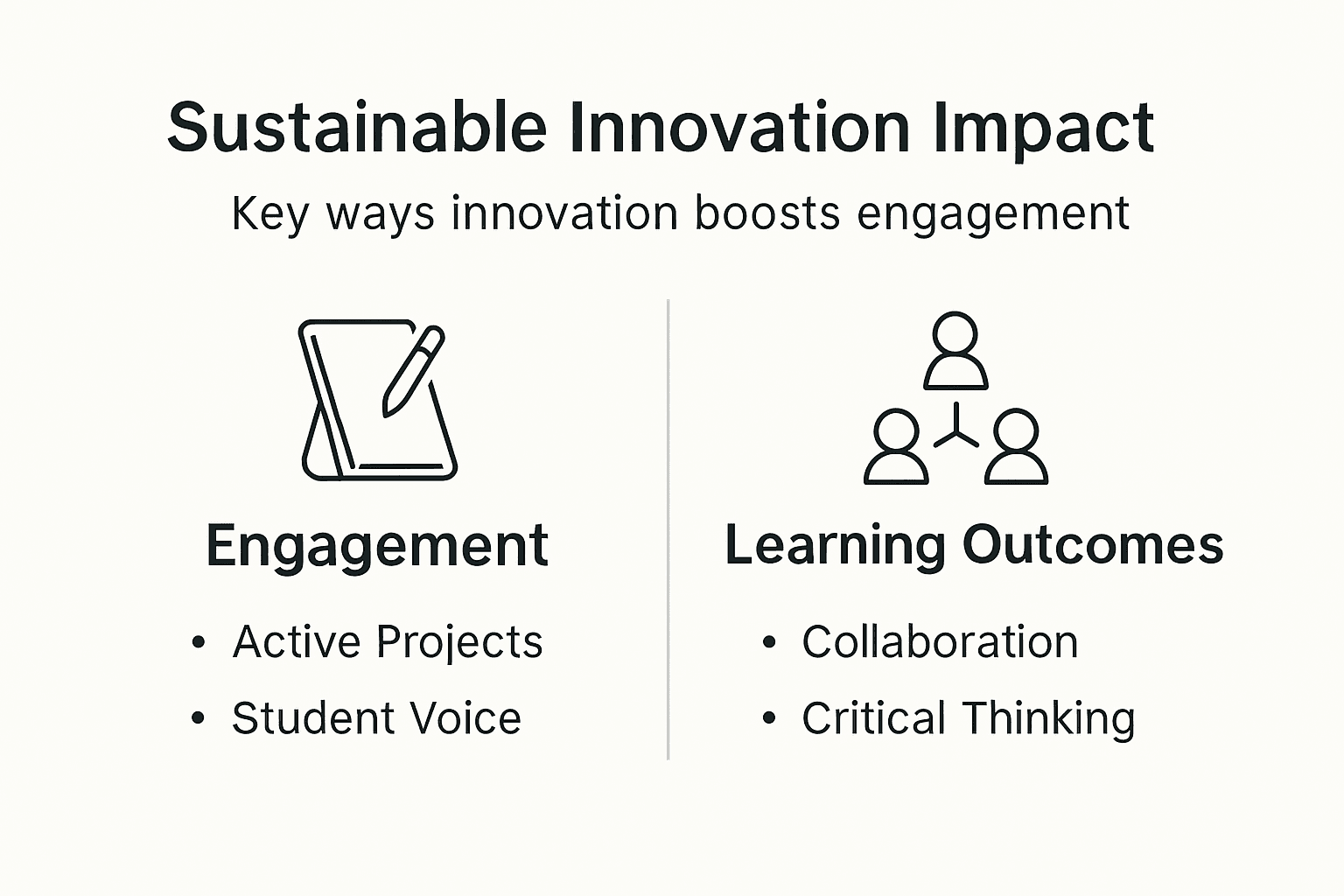
Developing a comprehensive sustainability action plan helps translate framework assessment into concrete implementation steps. Effective plans specify goals, timelines, responsible parties, resource needs, and success metrics.
Bridging sustainable innovation to practical education applications
Translating principles into practice requires both strategic vision and tactical execution. Pandemic recovery plans integrate sustainability to reduce inequities and enhance engagement for underserved students. This integration serves dual purposes: addressing environmental challenges while promoting educational equity.
Practical application strategies include:
- Start with existing content: Identify current units naturally connecting to sustainability themes, then deepen real-world relevance and application components.
- Partner with community organizations: Environmental groups, social enterprises, and local government agencies provide authentic project contexts and expert mentorship.
- Use participatory methods: UNESCO’s participatory action research approach in schools increases ownership and effectiveness of sustainability education.
- Leverage student leadership: Empower students to identify sustainability challenges they find compelling, supporting their inquiry rather than prescribing topics.
- Document and share: Create feedback loops where students present findings to authentic audiences beyond the classroom.
Active, contextualized approaches lead to deeper commitment and skill development compared to passive learning about sustainability issues. When students research local water quality, design waste reduction systems for their school, or develop renewable energy proposals for their community, they experience learning as purposeful action rather than academic obligation.
The prototyping sustainability in education approach exemplifies how hands-on innovation drives both engagement and learning. Students develop prototypes, test them, gather feedback, and iterate—mirroring professional innovation processes while building resilience and creative confidence.
Scaling successful pilots requires attention to teacher preparation, resource allocation, and assessment alignment. Professional learning communities where educators share sustainability pedagogy experiences accelerate adoption and refinement.
Conclusion: Transforming education with sustainable innovation
Sustainable innovation represents more than a curricular trend; it offers a fundamental strategy for preparing students to navigate complexity, uncertainty, and change. The evidence demonstrates clear benefits: enhanced motivation, deeper engagement, development of critical thinking and ethical reasoning, and preparation for meaningful participation in addressing planetary challenges.
Overcoming implementation barriers requires committed leadership and structured approaches. Frameworks like SHE-IMM provide roadmaps for progressive transformation, allowing institutions to build capacity systematically rather than attempting wholesale change. Success stories consistently feature collaboration across traditional boundaries—between disciplines, between schools and communities, and between students and educators as co-learners.
“Education for sustainability is not about adding new content to already crowded curricula. It’s about transforming how we teach and learn, empowering students as active agents in creating the future they will inherit.”
Collaborative models exemplify ethics-driven, global student innovation at scale. When young people from diverse contexts work together on shared challenges, they develop not only technical solutions but also intercultural competence and global citizenship.
Adopting these principles positions educational institutions to meet emerging societal needs while creating more engaging, meaningful learning environments. The question facing education leaders is not whether to integrate sustainable innovation, but how quickly and effectively they can implement it to serve their students and communities.
Empower your educational innovation with Mars Challenge
Ready to transform theory into action? Mars Challenge provides structured programs empowering students to tackle real sustainability challenges through team-based innovation in sustainability projects. Our Next Human Learning methodology cultivates the meta-skills, ethical intelligence, and collaborative innovation capacities your students need.
Educational leaders worldwide use our frameworks to run innovation challenges for youth teams, integrating authentic problem-solving into their curricula. Whether you’re beginning your sustainability journey or scaling existing initiatives, our resources and global community support your transformation goals. Visit Mars Challenge to explore how dual-planet innovation can elevate student engagement and learning outcomes in your institution.
Frequently asked questions
What are the key benefits of sustainable innovation for student engagement?
Sustainable innovation increases student motivation by connecting learning to urgent real-world challenges that feel personally relevant. Research shows engagement gains of up to 30% when curricula integrate authentic sustainability projects. Students develop agency, persistence, and deeper investment in their education.
How does sustainability education prepare students for future careers?
Sustainability education builds uniquely human capabilities that remain valuable as AI automates routine tasks. These include systems thinking, ethical reasoning, collaborative problem-solving, and adaptability to complexity. Employers increasingly prioritize these competencies across all sectors, not just environmental fields.
Can sustainability be integrated into non-science subjects?
Absolutely. Sustainability encompasses social justice, economics, ethics, design, communication, and cultural dimensions that naturally fit humanities and arts curricula. History classes examine environmental movements, literature explores human-nature relationships, and business courses analyze sustainable enterprise models. Integration enriches rather than replaces existing content.
What are common barriers to implementing sustainability education?
Institutional inertia, fragmented policies, limited teacher preparation, and traditional assessment systems create obstacles. Some educators feel unprepared to teach outside their discipline, while siloed departmental structures resist interdisciplinary collaboration. Addressing these requires leadership commitment, professional development, and incremental change strategies.
How can small schools with limited resources start sustainability education?
Begin by reframing existing content to emphasize real-world sustainability connections rather than creating entirely new courses. Partner with community organizations for project support and expertise. Use free online resources and engage students as co-designers of learning experiences. Small pilot projects build momentum and demonstrate value before requesting additional resources.
What role does student voice play in sustainability education?
Student voice is central because ownership drives engagement. When students identify challenges they care about and design their own inquiries, investment deepens significantly. Effective programs position students as knowledge creators and change agents rather than passive recipients, fundamentally altering the learning dynamic and developing leadership capacities.