

Many young innovators find systems thinking abstract or impractical when tackling sustainability challenges. Yet systems thinking is essential for addressing the complex, interconnected problems on Earth and Mars. This guide will help you understand core frameworks, avoid common misconceptions, and apply systems thinking effectively to create real-world solutions that integrate ecological, social, and technological dimensions for dual-planet sustainability.
Table of Contents
- Understanding Systems Thinking For Sustainability
- Core Frameworks And Models In Systems Thinking
- Educational Approaches To Systems Thinking For Sustainability
- Common Misconceptions About Systems Thinking
- Case Studies: Systems Thinking In Action On Earth And Mars
- Practical Application Of Systems Thinking For Young Innovators
- Summary And Next Steps: Cultivating Systems Thinking For Dual-Planet Sustainability
- Explore Mars Challenge And Advance Your Sustainability Skills
- Frequently Asked Questions
Key takeaways
| Point | Details |
|---|---|
| Systems thinking views challenges as interconnected webs, not isolated problems | Understanding feedback loops and interdependencies reveals leverage points for sustainable innovation |
| Key frameworks organize complexity into actionable models | The systemic sustainability framework integrates individual, organizational, societal, and planetary levels |
| Effective education uses visual modeling and interdisciplinary learning | Scaffolding and inquiry-based methods help learners engage with complexity without overload |
| Common misconceptions limit impact | Oversimplifying systems or ignoring social factors leads to ineffective solutions |
| Practical steps include mapping systems and iterative prototyping | Identify feedback loops, integrate diverse perspectives, and test ideas through real-world cycles |
Understanding systems thinking for sustainability
Systems thinking is the practice of understanding whole systems and their interconnections rather than isolated components. Traditional reductionist approaches break problems into parts, but sustainability challenges on Earth and Mars demand a holistic view because climate, food, energy, water, and social systems are deeply interdependent. Systems thinking requires moving beyond reductionist approaches to understand sustainability challenges as outcomes of complex socio-ecological systems.
The UN’s 17 Sustainable Development Goals illustrate this complexity. Each goal intersects with others: clean water affects health, agriculture, and ecosystems. Solving one issue in isolation often creates new problems elsewhere. For Mars habitats, life support systems must balance oxygen production, waste recycling, food growth, and energy use simultaneously. No single subsystem works alone.
This paradigm shift from linear cause-effect thinking to ecosystem-aware reasoning is essential for effective innovation. Young innovators must recognize that interventions ripple through systems, creating intended and unintended consequences. Multi-stakeholder collaboration becomes critical because diverse perspectives reveal hidden connections and feedback loops that single-discipline approaches miss. Applying planetary systems thinking principles helps you navigate these interconnected challenges.
Key aspects of systems thinking for sustainability include:
- Recognizing that outcomes emerge from interactions, not just individual actions
- Identifying feedback loops that amplify or dampen changes over time
- Understanding delays between actions and consequences in complex systems
- Embracing uncertainty and adapting strategies as new information emerges
- Integrating ethical considerations alongside technical solutions
Core frameworks and models in systems thinking
The systemic sustainability framework (SSF) organizes complexity into four interconnected levels: individual, organizational, societal, and planetary. At the individual level, values and behaviors shape consumption patterns and innovation mindsets. Organizations translate these into business models, governance structures, and operational practices. Societal systems include policies, cultural norms, and economic structures that enable or constrain sustainable action. The planetary level encompasses biophysical limits, climate dynamics, and resource cycles that all human activity depends on.
Core concepts within this framework include organizational purpose and legitimacy. Purpose defines why an organization exists beyond profit, aligning actions with sustainability goals. Legitimacy reflects how well an organization balances economic viability with social equity and planetary boundaries. Visual modeling and feedback loops are effective pedagogical strategies to promote systems-oriented understanding in diverse educational settings.
Feedback loops are central to systems thinking. Reinforcing loops amplify change, like population growth accelerating resource consumption. Balancing loops stabilize systems, like predator-prey dynamics maintaining ecosystem equilibrium. Understanding these dynamics helps you identify where interventions will have lasting impact versus where they’ll be absorbed or reversed by system structure.
| System Type | Example on Earth | Example on Mars |
|---|---|---|
| Reinforcing loop | Deforestation reduces rainfall, further stressing forests | Habitat leaks reduce pressure, increasing leak rate |
| Balancing loop | Carbon cycle balances atmospheric CO2 through oceans and plants | Thermal regulation balances heat input and radiation loss |
| Delayed feedback | Climate change effects lag decades behind emissions | Soil health impacts emerge seasons after cultivation |
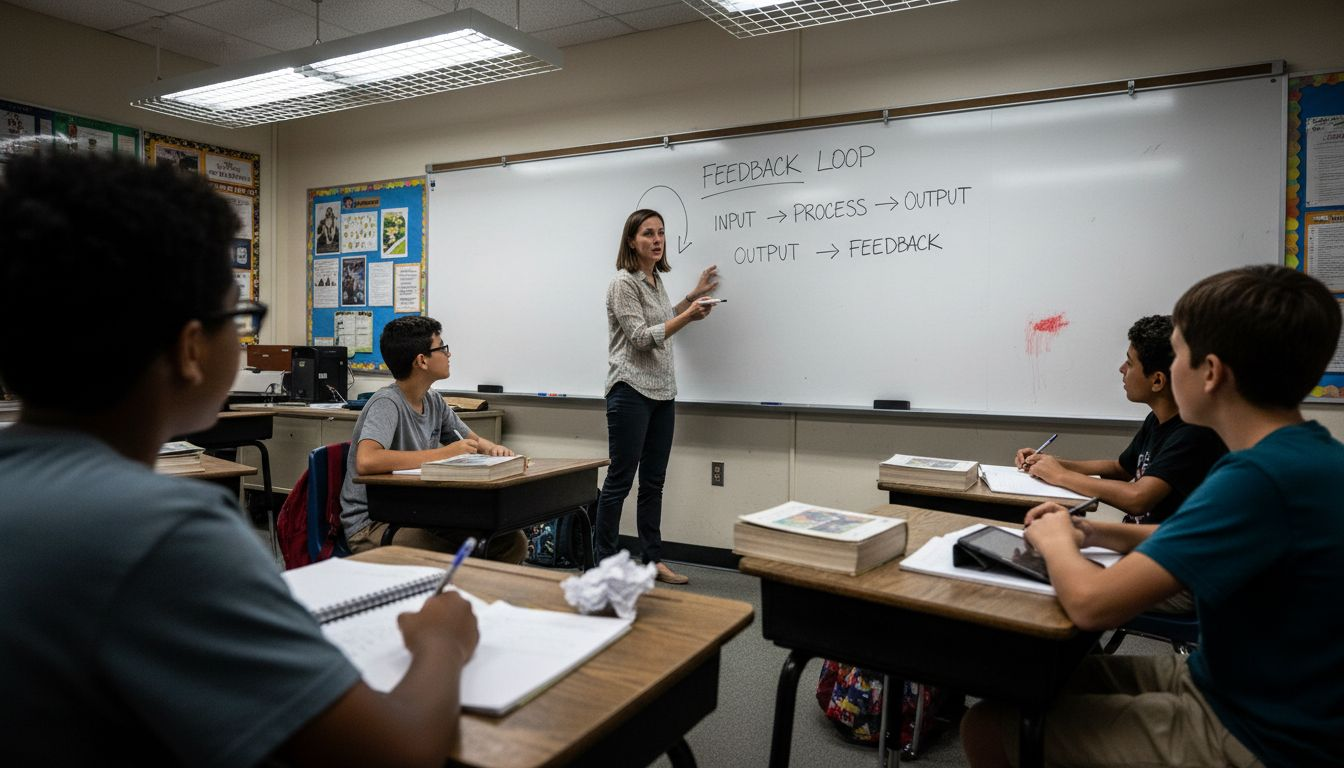
Traditional linear thinking assumes simple cause leads to effect. Systems thinking recognizes that effect loops back to influence cause, creating dynamic patterns over time. This distinction is critical when designing interventions that must remain effective as systems adapt and respond.
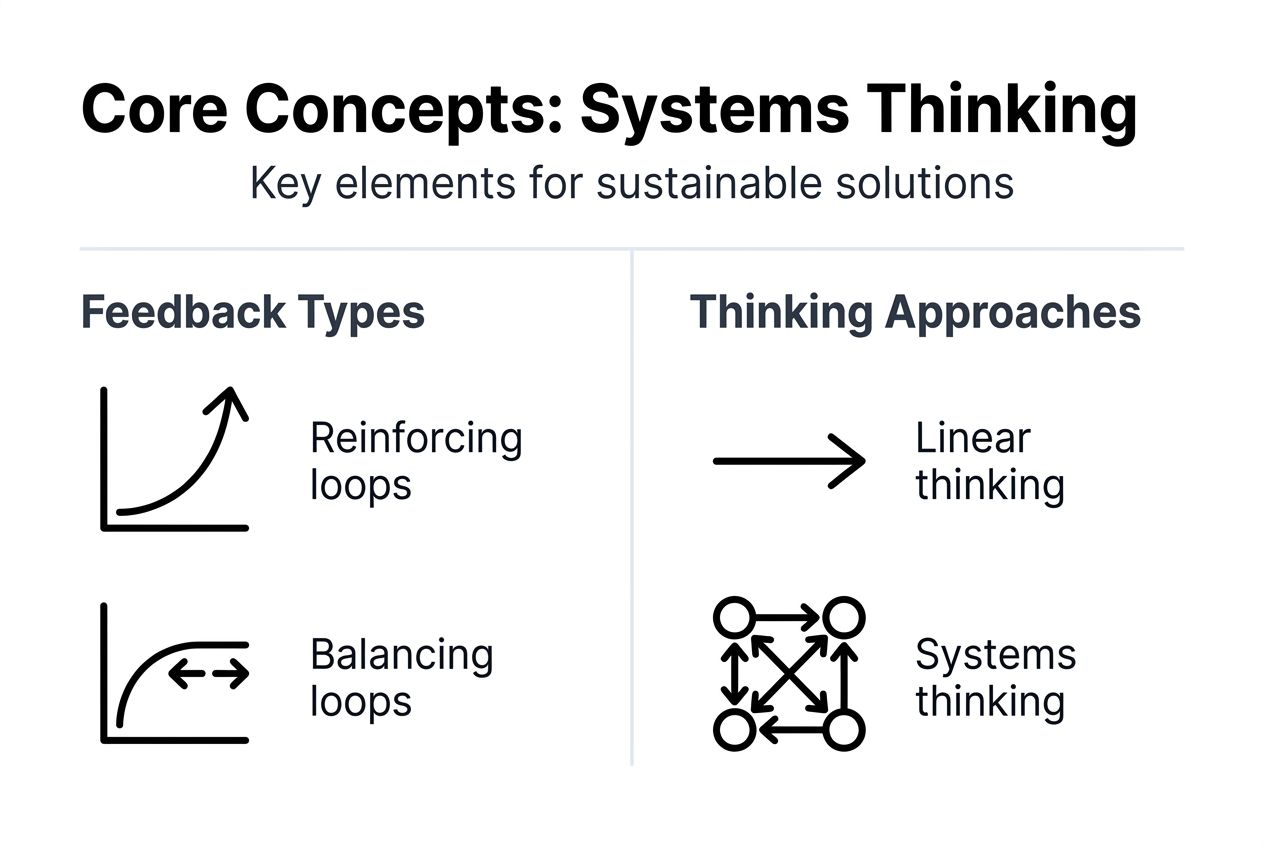
Pro Tip: Use data tables and visual feedback loop diagrams to simplify complex system interactions for learners. Draw arrows showing relationships, label loops as reinforcing or balancing, and identify key variables. This makes abstract concepts tangible and reveals non-obvious intervention points. Explore types of sustainability initiatives that apply these frameworks in practice.
Educational approaches to systems thinking for sustainability
Research shows that inter- and transdisciplinary education improves systems thinking competence. Interdisciplinary learning combines insights from multiple fields like biology, engineering, and social science to address sustainability challenges. Transdisciplinary approaches go further, engaging stakeholders outside academia including community members, policymakers, and industry partners. This integration mirrors real-world problem-solving where solutions must satisfy technical, social, economic, and ecological constraints simultaneously.
Visual modeling, simulations, and inquiry-based learning increase understanding of socio-ecological interactions. Computer simulations let learners manipulate variables and observe system behavior over time. Physical models like water cycle demonstrations make feedback loops concrete. Inquiry-based methods encourage learners to pose questions, test hypotheses, and discover system properties through exploration rather than passive instruction.
Scaffolding and timely support help learners engage with complexity without overload. Start with simplified models, then gradually introduce additional variables and relationships. Provide tools like system mapping templates and feedback loop diagrams. Inter- and transdisciplinary educational approaches that embrace complexity and provide timely support significantly foster systems thinking development in sustainability education.
Positive outcomes span K–12 to higher education settings. Students develop stronger ability to identify interconnections, anticipate unintended consequences, and design interventions that work with system dynamics rather than against them. These skills transfer across contexts from local community projects to global sustainability challenges.
Effective educational strategies include:
- Case studies of real systems showing how interventions succeeded or failed
- Role-playing exercises where learners represent different stakeholders
- Iterative design challenges requiring prototype testing and refinement
- Collaborative projects that mirror real-world interdisciplinary teamwork
Pro Tip: Integrate stakeholder perspectives and ethical discussions to deepen systemic insights. When analyzing a food system, include farmers, consumers, distributors, and ecosystem advocates. Discuss trade-offs between efficiency and resilience, short-term gains and long-term sustainability. These conversations reveal value conflicts and power dynamics that purely technical analysis misses. Check out planet-friendly project examples and education for climate innovation for inspiration.
Common misconceptions about systems thinking
One widespread misconception is that systems thinking is just simple linear cause-effect reasoning with more steps. In reality, systems thinking recognizes circular causality where effects loop back to influence causes, creating emergent behaviors that linear models cannot predict. Treating a complex system as a chain of causes misses the feedback loops and delays that generate surprising outcomes.
Another limiting belief is that systems thinking is too abstract to apply in practice. While systems thinking involves conceptual frameworks, its purpose is deeply practical: designing interventions that work within real-world complexity. The abstraction helps you see patterns across different contexts, but application requires translating insights into concrete actions, prototypes, and policies.
Many innovators overlook social and ethical complexity by focusing narrowly on technical fixes. A technically elegant solution that ignores cultural norms, power dynamics, or equity concerns will fail or cause harm. Water purification technology is useless if communities lack resources to maintain it or if its deployment disrupts local livelihoods. Systems thinking demands integrating technical, social, economic, and ecological dimensions from the start.
These misconceptions lead to ineffective or unsustainable solutions. Linear thinking produces interventions that trigger unintended side effects. Abstract theorizing without practical application wastes effort on ideas that don’t survive contact with reality. Techno-centric approaches create solutions that communities reject or that exacerbate inequality.
Holistic sustainability requires integrating social, ecological, and economic dimensions within system boundaries. Solutions must balance human needs, planetary limits, and ethical principles to create resilient futures on Earth and Mars. Ignoring any dimension produces fragile systems vulnerable to collapse or injustice.
Key misconceptions to avoid:
- Treating systems as static snapshots rather than dynamic processes evolving over time
- Assuming you can understand a system from a single disciplinary perspective
- Believing that more data automatically leads to better understanding without conceptual frameworks
- Focusing only on technical efficiency while neglecting resilience and adaptability
Case studies: systems thinking in action on Earth and Mars
The NASA M2M X-Hab academic innovation challenge engages university students in applying systems thinking to Mars habitat design. Students work in interdisciplinary teams to develop subsystems like life support, structures, and human factors. University-level innovation challenges connected to Mars exploration integrate systems thinking by engaging students in NASA mission critical paths with iterative design reviews and prototyping. Teams must show how their subsystem interfaces with others, analyzing feedback loops and trade-offs between mass, power, volume, and performance.
Iterative prototyping cycles force students to test assumptions and refine designs based on real-world constraints. Early prototypes reveal unforeseen interactions between subsystems. For example, a water recycling system might produce byproducts that affect air quality, requiring coordination with atmospheric control. These challenges develop systems thinking by making abstract concepts concrete through hands-on problem-solving.
Global Sustainability Challenge programs engage thousands of youth innovators tackling Earth and Mars sustainability. Participants frame problems systemically, identifying stakeholders, feedback loops, and leverage points before designing solutions. Mentorship connects young innovators with experts who guide systems analysis and prototype development. Funding awards support promising innovations and motivate teams to develop solutions with real-world impact.
Examples of systems thinking in action:
- Water systems: Teams map entire water cycles from collection through use to recycling, identifying where interventions reduce waste or improve quality while minimizing energy and material inputs.
- Food production: Innovators design closed-loop systems where waste from one process becomes input for another, like using food scraps for compost that grows new crops.
- Energy infrastructure: Students model renewable energy systems with storage and distribution, analyzing how variable supply and demand create feedback loops requiring smart grid management.
- Habitat design: Teams balance thermal regulation, structural integrity, radiation shielding, and life support in integrated designs where optimizing one parameter affects all others.
- Social systems: Projects address governance, education, and cultural adaptation for long-duration missions or Earth communities, recognizing that technical systems fail without social infrastructure.
These case studies demonstrate that systems thinking is not theoretical. It guides practical innovation by helping young people see connections, anticipate consequences, and design solutions that work with complexity rather than against it. Explore reimagining sustainable life systems for more examples.
Practical application of systems thinking for young innovators
Applying systems thinking effectively requires a structured approach. Follow these steps to translate conceptual understanding into actionable innovation:
- Map system boundaries and stakeholders: Define what’s inside and outside your system. Identify all stakeholders affected by or influencing the system. Include human and non-human actors like ecosystems or technologies.
- Identify feedback loops and dynamics: Trace how changes in one variable affect others and loop back. Label reinforcing loops that accelerate change and balancing loops that stabilize. Note delays between actions and consequences.
- Integrate diverse perspectives and ethics: Engage stakeholders with different expertise and values. Discuss trade-offs between efficiency, equity, resilience, and sustainability. Consider who benefits and who bears costs.
- Prototype iteratively with feedback loops: Build simple prototypes to test assumptions. Gather data on how the system responds. Refine designs based on observed dynamics and stakeholder input.
| Aspect | Traditional Linear Approach | Systems Thinking Approach |
|---|---|---|
| Problem framing | Single cause, single effect | Multiple interacting causes and feedback loops |
| Stakeholder engagement | Limited to direct users | Includes all affected parties and ecosystem impacts |
| Solution design | Optimize one metric | Balance multiple objectives within constraints |
| Testing | Controlled lab conditions | Real-world context with emergent behaviors |
| Iteration | Fix bugs and improve features | Adapt to system responses and unintended consequences |
Decision criteria for effective systems thinking:
- Choose system boundaries that capture key interactions without becoming unmanageable
- Include diverse stakeholders early to surface hidden assumptions and value conflicts
- Target leverage points where small interventions produce disproportionate positive change
- Design prototypes that are feasible to build and test within your resources
- Balance ambition with real-world constraints and planetary limits
Pro Tip: Avoid oversimplification by using system mapping tools and ethical intelligence frameworks. Draw causal loop diagrams showing all major relationships, not just convenient ones. Apply frameworks like the SSF to ensure you’re considering individual, organizational, societal, and planetary dimensions. Discuss ethical implications with diverse stakeholders to reveal blind spots. Complexity is irreducible, but tools help you engage with it productively. Follow a step-by-step sustainability action plan and explore types of sustainability initiatives to guide your process.
Summary and next steps: cultivating systems thinking for dual-planet sustainability
Systems thinking is essential for solving complex sustainability challenges on Earth and Mars because it reveals the interconnections, feedback loops, and emergent behaviors that simpler approaches miss. Educational frameworks like the systemic sustainability framework and practical methods such as visual modeling, stakeholder engagement, and iterative prototyping enable meaningful application for young innovators. Innovation must integrate ethical and systemic awareness for real-world impact, balancing technical performance with social equity and planetary limits.
Key takeaways for your journey:
- Start by mapping your system and identifying all stakeholders and feedback loops
- Use interdisciplinary learning and visual tools to make complexity manageable
- Prototype iteratively, learning from how systems respond to your interventions
- Engage diverse perspectives to surface hidden assumptions and ethical considerations
- Balance ambition with feasibility, targeting leverage points for maximum impact
Engage with programs like Mars Challenge 2026 to continue improving systems thinking skills through real-world challenges. Collaborate with global communities of young innovators tackling Earth and Mars sustainability. Innovate iteratively, learning from successes and failures. Systems thinking is not a one-time skill acquisition but an ongoing practice of seeing connections, anticipating consequences, and designing solutions that create resilient, equitable, and sustainable futures on both planets.
Explore Mars Challenge and advance your sustainability skills
Ready to apply systems thinking to real-world sustainability challenges? Mars Challenge 2026 offers programs focusing on dual-planet innovation, connecting you with mentors, resources, and a global community of young innovators. Our sustainability action plan provides step-by-step guidance for turning ideas into prototypes that integrate technical, social, and ecological dimensions.
Participate in challenges that integrate systems thinking and real-world prototyping, culminating in The Grand Jam 2026 where teams present solutions reimagining Earth’s life-support systems. Whether you’re passionate about climate, food, energy, or habitat design, Mars Challenge provides the structure, support, and community to transform your systems thinking skills into tangible impact. Start your journey toward systemic sustainability solutions today.
Frequently asked questions
What is systems thinking and why is it important for sustainability?
Systems thinking is the practice of understanding interconnections in complex systems rather than analyzing isolated components. It’s crucial for sustainability because ecological, social, and technological challenges are deeply interdependent. Climate change affects water, agriculture, energy, and human health simultaneously. Solving one issue in isolation often creates problems elsewhere. On Mars, life support systems must balance oxygen, water, food, and energy as an integrated whole. Systems thinking helps you design solutions that work across these domains, anticipating ripple effects and feedback loops that linear approaches miss.
How can young innovators apply systems thinking in their projects?
Start by mapping your system and identifying key stakeholders including communities, ecosystems, and technologies. Use feedback loops to understand how changes amplify or balance over time. Test ideas through prototyping and iteration, gathering data on how the system responds. Include diverse perspectives and ethical considerations from the beginning, discussing trade-offs between efficiency, equity, and sustainability. Programs like Mars Challenge provide structured opportunities to practice these skills with mentorship and real-world challenges.
What educational methods best foster systems thinking skills?
Use interdisciplinary and transdisciplinary learning that combines insights from multiple fields and engages stakeholders outside academia. Incorporate visual modeling like causal loop diagrams and simulations that let learners manipulate variables and observe dynamics. Inter- and transdisciplinary educational approaches that embrace complexity and provide timely support significantly foster systems thinking development. Provide scaffolding through templates, frameworks, and iterative challenges that gradually increase complexity. Inquiry-based methods where learners pose questions and discover patterns are more effective than passive instruction.
What are common mistakes to avoid when using systems thinking?
Avoid oversimplifying systems as linear or static when they’re actually dynamic with feedback loops and delays. Do not ignore social and ethical dimensions by focusing narrowly on technical fixes. Solutions must work for real communities within cultural, economic, and political contexts. Beware of treating systems thinking as purely theoretical without application. Gather diverse stakeholder input early and often to surface hidden assumptions and value conflicts. Testing prototypes in real-world conditions reveals dynamics that conceptual analysis misses.