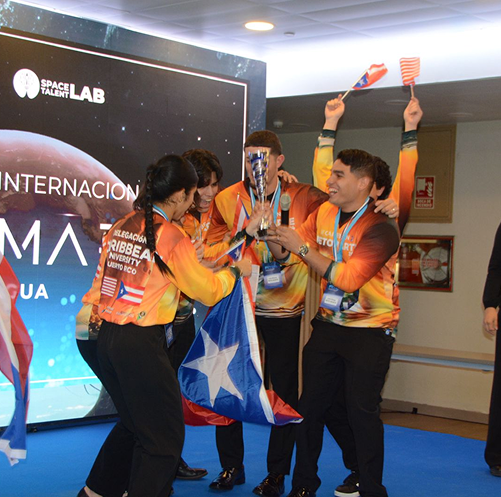


Choosing the right innovation trends for your curriculum in 2026 requires more than tracking headlines. Educators and curriculum developers face the challenge of distinguishing genuine pedagogical advances from fleeting tech fads. This article presents six innovation trends evaluated through a rigorous framework balancing technology, pedagogy, and real-world impact. Each trend addresses climate change, sustainability, and future skills development while offering immediate practical applications for secondary schools and universities seeking to engage students aged 15 to 29 in meaningful, transformative learning experiences.
Table of Contents
- Criteria For Evaluating Innovation Trends In Education
- AI-Driven Personalized Learning And Assessment
- Immersive Climate Change Education And Sustainability Projects
- Blockchain And Microcredentials For Secure, Flexible Certification
- Smart Campus Facility Management And Sustainability Impact
- Empower Your Education Innovation With Mars Challenge
- Frequently Asked Questions
Key takeaways
| Point | Details |
|---|---|
| Selection criteria matter | Evaluate innovations by pedagogical integration, technological feasibility, sustainability impact, and student engagement to ensure strategic alignment. |
| AI personalizes learning | AI-driven platforms boost engagement by 30% and improve test scores by 20% through adaptive tutoring and mental health support. |
| Immersive climate education | VR simulations increase climate understanding by 25%, while project-based learning drives 40% more student-led sustainability initiatives. |
| Blockchain secures credentials | 50% more institutions explore blockchain for tamper-proof records, while microcredentials enable flexible, skill-based career pathways. |
| Smart campuses reduce costs | IoT and predictive maintenance cut unplanned equipment failures by 62% and save $740,000 annually in emergency spending. |
Criteria for evaluating innovation trends in education
Before adopting any educational innovation, you need clear evaluation criteria. Strategic misalignment in EdTech can delay progress by years, making institutional competitiveness harder to recover. The most effective innovations balance human-centric pedagogy with technological capability, ensuring tools enhance rather than replace quality teaching.
Consider four core criteria when evaluating trends. First, assess pedagogical integration: does the technology support your teaching philosophy and learning outcomes? Second, examine technological feasibility: can your institution implement and maintain the solution with existing resources? Third, evaluate sustainability impact: does the innovation reduce environmental footprint or teach climate literacy? Fourth, measure student engagement potential: will it motivate learners and develop future-ready skills?
A key pitfall is over-reliance on technology without proper pedagogical integration. Educators must ensure technology enhances effective teaching methods. When evaluating sustainability and AI education trends 2026, prioritize solutions that address equity and access alongside innovation.
Key evaluation factors include:
- Alignment with institutional mission and values
- Evidence of measurable learning outcomes
- Scalability across different student populations
- Integration with existing curriculum frameworks
- Support for educator professional development
Pro Tip: Create a scoring rubric weighting these criteria based on your institution’s priorities. Test innovations with small pilot programs before committing to campus-wide implementation.
AI-driven personalized learning and assessment
Artificial intelligence has moved from experimental to essential in 2026 education. AI-driven personalized learning platforms increase engagement by 30% and improve test scores by 20%, making them among the most impactful innovations available. These platforms adapt content difficulty, pacing, and presentation style to individual student needs, creating customized learning pathways that traditional instruction cannot match.
The widespread adoption reflects student behavior. 86% of students use AI tools weekly in their studies, integrating these technologies naturally into research, writing, and problem-solving workflows. Rather than resisting this shift, forward-thinking educators harness AI to enhance teaching effectiveness and provide real-time feedback that supports student growth.
AI platforms particularly benefit mental health and wellbeing. Adaptive systems detect when students struggle and adjust difficulty to prevent frustration and disengagement. They identify learning gaps early, enabling timely intervention before students fall behind. This personalized approach reduces anxiety and builds confidence, especially for learners who need more time or alternative explanations.
Key benefits of AI-driven learning:
- Real-time assessment and immediate corrective feedback
- Data-driven insights into student progress and challenges
- Automated grading freeing educators for higher-value interactions
- Multilingual support expanding access for diverse learners
- Predictive analytics identifying at-risk students early
Explore how AI and sustainability education trends intersect to create powerful learning experiences that prepare students for climate challenges while developing technological literacy.
Pro Tip: Balance AI tools with human guidance. Use AI for skill practice and assessment, but reserve complex discussions, ethical reasoning, and collaborative projects for face-to-face interaction where human judgment and empathy matter most.
Immersive climate change education and sustainability projects
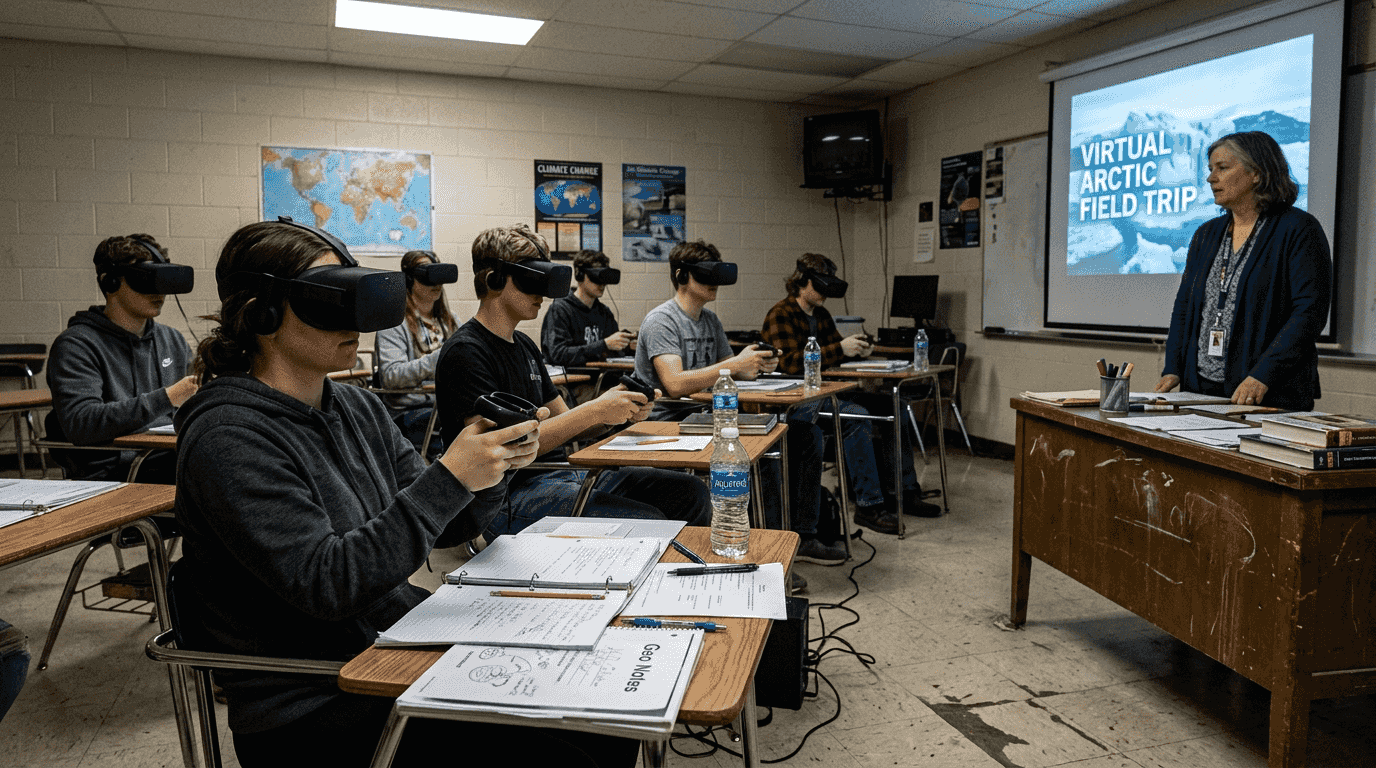
Climate change education demands more than textbook facts. Immersive technologies and project-based learning create emotional connections and practical skills that drive real behavior change. VR simulations increase student understanding of climate impacts by 25%, making abstract concepts like sea level rise, ecosystem collapse, and carbon cycles tangible and urgent.
Virtual field trips transport students to melting glaciers, coral reefs, and deforested regions without carbon emissions from travel. These experiences build empathy and systems thinking as students witness interconnected environmental challenges. When paired with data visualization, VR helps learners grasp the scale and complexity of climate systems in ways traditional media cannot achieve.
Project-based sustainability curricula amplify this understanding through action. Schools report a 40% increase in student-led sustainability initiatives when implementing project-based learning. Students design solar installations, launch campus composting programs, conduct energy audits, and prototype circular economy solutions that address real community needs.
This hands-on approach develops critical competencies: design thinking, collaboration, data analysis, and ethical decision-making. Students learn to navigate trade-offs, manage resources, and communicate complex ideas to diverse stakeholders. These meta-skills transfer across disciplines and prepare learners for careers in the emerging green economy.
| Approach | Student Engagement | Skill Development | Real-World Impact |
|---|---|---|---|
| Traditional lectures | Low to moderate | Knowledge retention | Minimal |
| VR simulations | High | Empathy and systems thinking | Moderate |
| Project-based learning | Very high | Design, collaboration, problem-solving | Significant |
Discover planet-friendly student projects that combine innovation with environmental stewardship. Learn how to reimagine sustainability education 2026 impact through curriculum design that prioritizes action and agency.
Pro Tip: Ground projects in local environmental challenges. Students engage more deeply when addressing issues they witness daily, from urban heat islands to water quality, building connections between global climate science and community resilience.
Blockchain and microcredentials for secure, flexible certification
Credentialing systems are undergoing radical transformation. Blockchain technology provides tamper-proof, portable academic records that students control and share across institutions and employers. 50% more educational institutions explore blockchain for credentialing by 2026, recognizing its potential to streamline verification and reduce administrative burden.
Blockchain solves persistent problems in education: transcript fraud, credential verification delays, and lack of interoperability between systems. Students receive digital credentials stored on distributed ledgers, enabling instant verification without intermediaries. This transparency builds trust while giving learners ownership of their educational achievements.
Microcredentials complement blockchain by unbundling traditional degrees into modular, skill-specific certifications. Microcredentials are modular certifications recognized by industries and universities, enabling greater professional mobility. Learners earn credentials for specific competencies like data analysis, sustainable design, or ethical AI development, creating customized portfolios that reflect actual capabilities rather than generic degree titles.
This shift supports lifelong learning and career adaptability. As industries evolve rapidly, professionals need continuous skill updates without returning to multi-year degree programs. Microcredentials provide targeted, efficient pathways for upskilling and career transitions, particularly valuable in sustainability and technology sectors experiencing explosive growth.
Key blockchain benefits in education:
- Permanent, tamper-proof record keeping
- Student ownership and control of credentials
- Instant verification reducing administrative costs
- Interoperability across institutions and borders
- Enhanced privacy and data security
Explore how blockchain and microcredentials in education enable innovative approaches to competency-based learning and portfolio development.
Smart campus facility management and sustainability impact
Operational efficiency directly affects educational sustainability. Smart facility management using IoT sensors, predictive analytics, and digital twins transforms campus infrastructure from reactive maintenance to proactive optimization. Smart maintenance strategies reduce unplanned equipment failures by 62% and cut emergency spending by $740,000 annually, demonstrating substantial financial and environmental benefits.
Predictive maintenance uses sensor data to identify equipment degradation before failures occur. HVAC systems, electrical infrastructure, and water management benefit from continuous monitoring that schedules repairs during planned downtime rather than responding to emergencies. This approach extends asset lifespan, reduces waste, and lowers carbon emissions from inefficient or failing systems.
Digital twins create virtual replicas of physical campuses, enabling scenario testing and optimization without disrupting operations. Facilities managers simulate energy-saving strategies, test emergency response protocols, and optimize space utilization using real-time data. These capabilities support sustainability goals while improving student and staff experiences through better environmental conditions.
Smart campuses also address the sustainability paradox of digital education. Digital education balances expanded access with increased energy demand, posing sustainability challenges. Smart infrastructure mitigates this by optimizing data center efficiency, renewable energy integration, and building automation that reduces overall consumption even as digital services expand.
| Metric | Before Smart Systems | After Implementation | Improvement |
|---|---|---|---|
| Unplanned failures | 100 incidents/year | 38 incidents/year | 62% reduction |
| Emergency spending | $1.2 million | $460,000 | $740,000 saved |
| Energy consumption | Baseline | Optimized | 18% reduction |
“Successful smart campus implementation requires a phased approach. Start with high-impact systems like HVAC and lighting, demonstrate ROI, then expand to comprehensive infrastructure management. Change management and staff training prove as critical as technology selection.” — Campus Facilities Director, Major Research University
Learn how smart facility management sustainability integrates with open-source solutions for cost-effective implementation in higher education.
Empower your education innovation with Mars Challenge
These innovation trends converge in Mars Challenge’s mission to reimagine education for planetary survival. Our dual-planet innovation mission engages students in high-impact challenges that develop the exact competencies these trends cultivate: systems thinking, ethical AI use, sustainability design, and collaborative problem-solving.
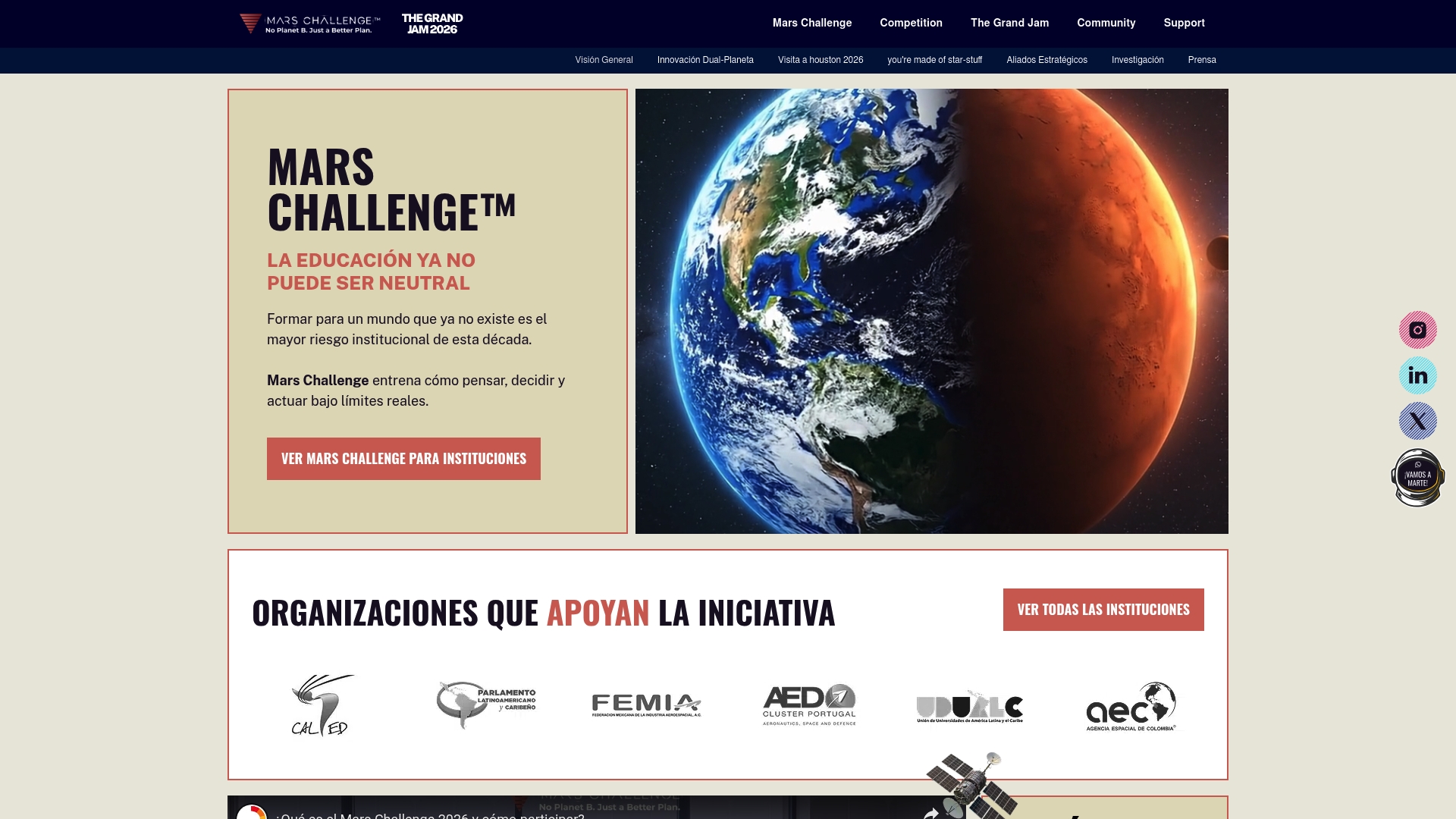
Mars Challenge provides ready-to-implement frameworks for future climate innovation education that align with AI-driven learning, immersive sustainability projects, and competency-based credentialing. Discover how to run innovation challenge youth teams that prototype real solutions while developing the meta-skills demanded by employers and graduate programs. Join educators in over 20 countries cultivating the next generation of planetary innovators.
Frequently asked questions
What are the main barriers to adopting new educational technologies in 2026?
Financial constraints, technological differences, policy fragmentation, and data privacy rank among common adoption challenges. Budget limitations force difficult choices between competing priorities, while legacy systems create integration headaches. Policy inconsistencies across districts and regions complicate standardization, and privacy regulations require careful data governance. Digital equity remains critical; without addressing access gaps, technology adoption risks widening rather than closing achievement disparities between well-resourced and under-resourced communities.
How can educators balance technology use with effective teaching methods?
Technology should enhance teaching, not replace it. The most effective approach blends human guidance with AI tools, using technology for skill practice, assessment, and content delivery while reserving complex discussions, ethical reasoning, and collaborative projects for face-to-face interaction. Start by identifying specific learning challenges technology solves better than traditional methods, then design hybrid experiences that leverage both digital and human strengths. Continuous professional development helps educators develop technological fluency while maintaining pedagogical expertise.
What role do microcredentials play in future education and career pathways?
Microcredentials are modular certifications recognized by industries and universities, facilitating professional mobility. They enable targeted skill validation without committing to full degree programs, supporting lifelong learning and career adaptability. As industries evolve rapidly, particularly in sustainability and technology sectors, microcredentials provide efficient pathways for upskilling and career transitions. They complement traditional degrees by documenting specific competencies employers value, creating portfolios that reflect actual capabilities rather than generic credentials.
How do VR simulations improve climate change education outcomes?
VR creates emotional connections and spatial understanding impossible through traditional media. Students experience climate impacts viscerally, witnessing ecosystem changes and human consequences that build empathy and urgency. The technology makes abstract concepts like carbon cycles and feedback loops tangible through interactive visualization and data overlays. Combined with guided reflection and project-based application, VR simulations transform passive learning into active engagement that drives behavior change and systems thinking development.
What makes smart campus infrastructure sustainable beyond energy savings?
Smart infrastructure extends asset lifespan through predictive maintenance, reducing manufacturing demand and waste from premature replacement. Optimized systems lower water consumption, minimize chemical use in facility management, and enable renewable energy integration through intelligent load balancing. Digital twins support circular economy principles by tracking material flows and identifying reuse opportunities. Beyond direct environmental benefits, smart campuses model sustainability practices that educate students through daily experience, embedding environmental literacy into institutional culture rather than limiting it to classroom instruction.