

Most people assume prototyping means waste. They picture discarded foam models, failed 3D prints, and materials destined for landfills. But sustainable prototyping flips this narrative entirely. By integrating circular design principles, low-impact materials, and digital tools from the start, young innovators can prototype solutions for planetary challenges without harming Earth or future habitats beyond it. This guide shows you how to build, test, and refine ideas using methods that reduce environmental impact while accelerating innovation for both our planet and Mars.
Table of Contents
- Understanding Sustainable Prototyping And Its Role In Innovation
- Techniques And Materials For Reducing Environmental Impact In Prototyping
- Innovations In Planetary Prototyping: Building Sustainable Solutions Beyond Earth
- Integrating Sustainable Prototyping In Education And Innovation Ecosystems
- Explore Dual-Planet Innovation Challenges With Mars Challenge
Key takeaways
| Point | Details |
|---|---|
| Circular principles reduce waste | Sustainable prototyping embeds reuse, modularity, and biodegradable materials from the design phase to minimize environmental harm. |
| Digital tools cut physical iterations | AR/VR simulations and digital twins validate concepts before building physical prototypes, saving materials and energy. |
| Active learning builds sustainability skills | Project-based education empowers young innovators to solve real-world challenges through hands-on design thinking and collaboration. |
| Space innovations advance Earth solutions | Technologies like Cold Sintering Process and bio-regolith composites enable sustainable building on Mars while informing circular practices on Earth. |
Understanding sustainable prototyping and its role in innovation
Sustainable prototyping merges innovation with environmental responsibility. Instead of treating waste as an inevitable byproduct of iteration, it treats every material choice and design decision as an opportunity to reduce impact. Prototyping is an indispensable part of the design thinking process, helping teams test assumptions, gather feedback, and refine solutions before committing resources to final production.
The difference lies in embedding circularity from day one. Traditional prototyping often prioritizes speed over sustainability, leading to single-use models and material excess. Sustainable prototyping flips this by asking: Can we reuse components? Can materials biodegrade or return to production cycles? Can digital simulations replace physical builds in early stages? These questions transform prototyping from a wasteful necessity into a regenerative practice.
Young innovators tackling climate, food systems, and habitat design need this approach. Whether you’re designing water filtration for drought-prone regions or life support systems for Mars habitats, your prototypes should reflect the sustainability values your final solutions aim to achieve. Active learning strategies, such as project-based learning and design thinking, effectively foster sustainability competencies by connecting hands-on experimentation with real-world impact.
This isn’t just about materials. Sustainable prototyping develops cognitive flexibility, systems thinking, and collaborative problem solving. You learn to navigate trade-offs between performance, cost, and environmental impact. You practice iterating within constraints, a skill essential for designing solutions that work on resource-limited planets or in communities facing scarcity. Explore how sustainable prototyping education integrates these competencies into youth-led innovation programs globally.
Pro Tip: Start every prototype cycle by listing what materials you’ll recover, reuse, or recycle at the end. This forces intentional design choices and prevents waste from becoming an afterthought.
Techniques and materials for reducing environmental impact in prototyping
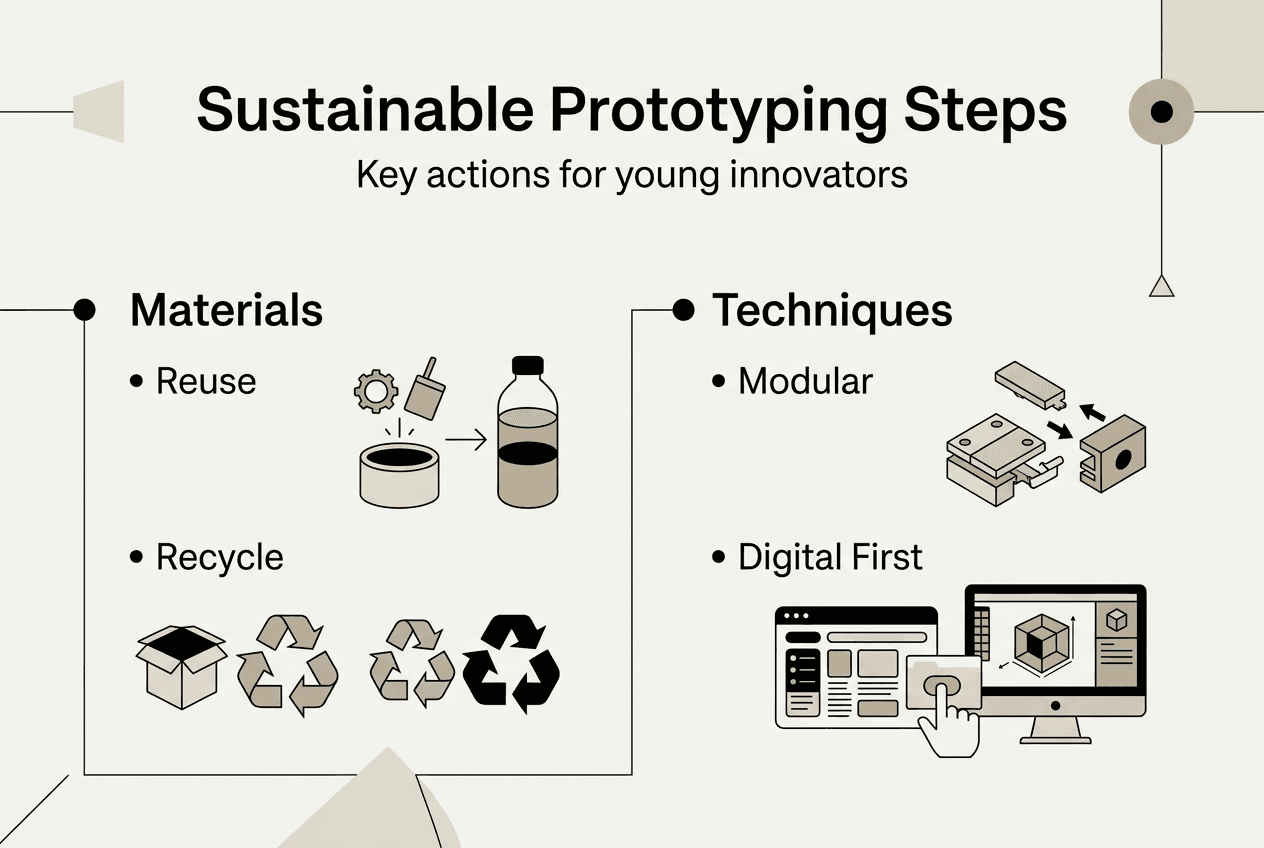
Material selection drives sustainability outcomes. Choosing biodegradable plastics like PLA over petroleum-based ABS for 3D printing reduces long-term environmental harm. Cardboard, bamboo, and recycled foam offer structural testing capabilities without toxic residues. Prioritizing low-impact materials in early prototyping phases significantly reduces your project’s carbon footprint while maintaining design flexibility.
Here’s a practical framework for material choices:
- Assess biodegradability and toxicity before purchasing any prototyping material.
- Source recycled or reclaimed materials whenever structural requirements allow.
- Design components for disassembly so parts can be separated and reused in future iterations.
- Document material performance to build a reusable knowledge base for your team.
- Partner with local makerspaces or recycling centers to establish material return loops.
Modular prototyping amplifies these benefits. Instead of building entire systems from scratch for each test, design interchangeable components that snap together. Test one subsystem at a time, swapping modules as you refine performance. This approach cuts material use by 40 to 60 percent compared to full-system rebuilds while accelerating iteration speed.
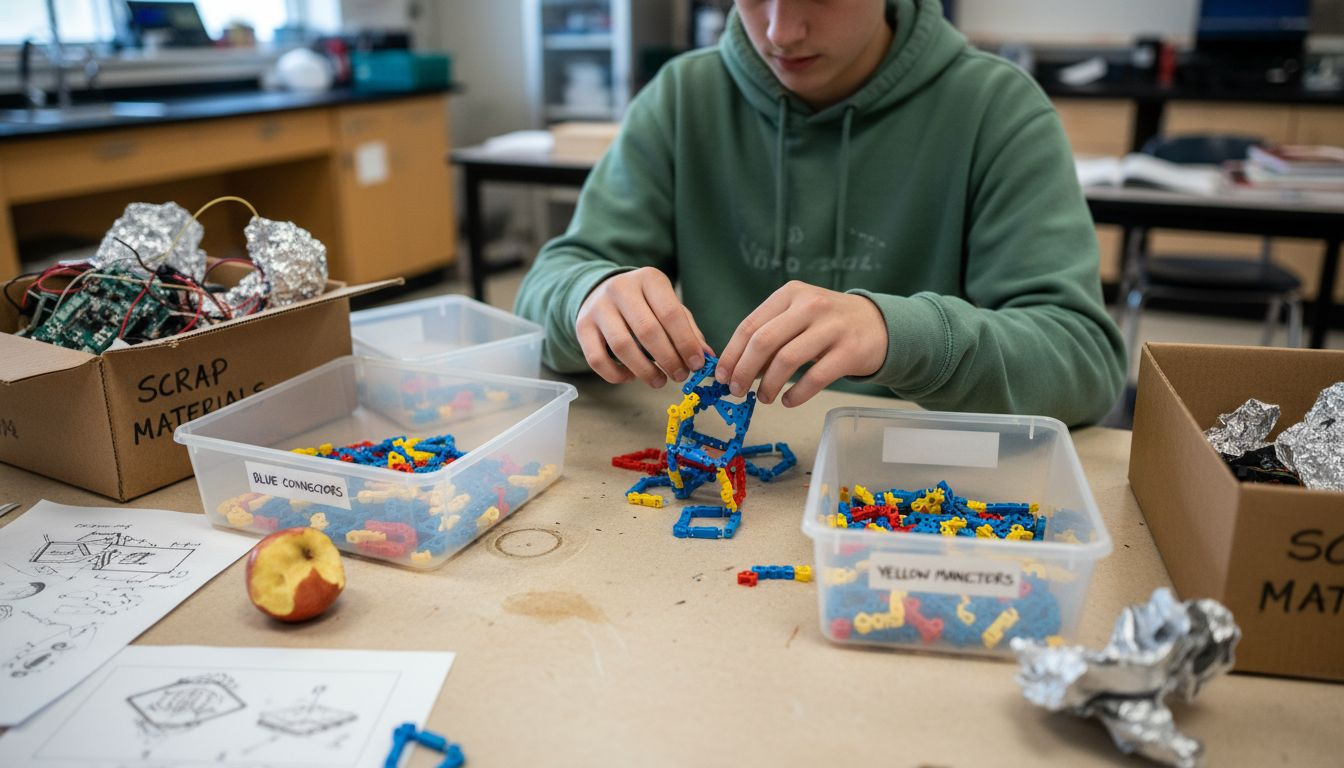
Digital tools eliminate many physical prototypes entirely. Digital prototyping tools can reduce the need for physical mock-ups, especially in early validation stages. Augmented reality lets you visualize designs at scale in real environments. Virtual reality enables user testing without manufacturing physical models. Digital twins simulate stress, thermal performance, and failure modes, revealing design flaws before you cut a single piece of material.
| Material | Environmental Profile | Best Use Cases | Limitations |
|---|---|---|---|
| PLA (Polylactic Acid) | Biodegradable, plant-based, low toxicity | 3D printed structural tests, concept models | Lower heat resistance than ABS |
| Recycled Cardboard | Fully recyclable, minimal processing energy | Form studies, packaging prototypes, lightweight structures | Limited durability in moisture |
| Bamboo | Rapidly renewable, high strength-to-weight ratio | Frameworks, handles, structural elements | Requires specialized cutting tools |
| Recycled Foam | Diverts waste, cushioning properties | Impact testing, ergonomic mockups | May contain adhesives or coatings |
| Mycelium Composites | Grows from agricultural waste, fully compostable | Insulation, packaging, organic forms | Longer growth cycles, variable strength |
Designing for disassembly ensures materials have life beyond a single prototype. Use mechanical fasteners instead of adhesives. Choose snap-fit joints over permanent bonds. Label components with material types to simplify sorting. When your prototype reaches end-of-life, it becomes a material library for the next project instead of landfill waste. This practice mirrors how spacecraft designers plan for component recovery and reuse in closed-loop habitats.
Pro Tip: Keep a material scrap bin organized by type and size. Small offcuts from previous prototypes often eliminate the need to source new materials for quick tests, and you’ll discover creative solutions by working within available constraints.
Learn how these methods connect to broader sustainability initiatives for youth programs worldwide.
Innovations in planetary prototyping: Building sustainable solutions beyond Earth
Space exploration demands radical sustainability. You can’t ship unlimited materials to Mars, and every kilogram launched from Earth costs thousands of dollars. This constraint drives innovations that redefine sustainable prototyping for both planets. Cold Sintering Process (CSP) can produce high-strength regolith bricks exceeding 200 MPa at low energy cost, using lunar or Martian soil as the primary building material.
CSP works by applying pressure and modest heat (under 300°C) to compact regolith particles with small amounts of binder. Compare this to traditional ceramic sintering requiring 1000°C or more. The energy savings make CSP viable for solar-powered equipment on planetary surfaces. More importantly, it creates structural materials from local resources, embodying the ultimate circular economy principle: zero waste, zero imports.
Cyanobacteria-regolith composites push this further. 3D printing of composites of Martian regolith simulants and cyanobacterial biomass advances sustainable material production by combining mineral strength with biological binding. Cyanobacteria grow using Martian atmospheric CO2 and minimal water, creating printable biomass that reinforces regolith structures. This living material approach turns Mars itself into a manufacturing resource.
Key advantages of planetary prototyping methods:
- Eliminate dependence on Earth supply chains for construction materials
- Reduce launch mass and mission costs by factors of 10 or more
- Enable rapid habitat expansion as colony populations grow
- Demonstrate closed-loop manufacturing essential for long-term space settlement
- Provide testbeds for ultra-efficient circular practices applicable on Earth
| Challenge | Earth Prototyping | Space Prototyping |
|---|---|---|
| Material availability | Abundant, diverse suppliers | Extremely limited, must use local regolith |
| Energy constraints | Grid power readily available | Solar-dependent, must minimize consumption |
| Waste disposal | Recycling infrastructure exists | Zero-waste mandatory, no landfills |
| Testing environment | Controlled labs, outdoor sites | Vacuum, radiation, extreme temperatures |
| Iteration speed | Fast shipping, easy replacements | Months between resupply, high failure cost |
| Design philosophy | Optimize for performance and cost | Optimize for reuse and resource efficiency |
These space innovations inform Earth applications. If you can 3D print structures from local soil on Mars, you can do it in remote areas lacking traditional building materials. If you can create closed-loop manufacturing in a habitat with no external inputs, you can design regenerative factories on Earth that eliminate industrial waste. The constraints of space force breakthrough thinking that accelerates sustainability everywhere.
Discover how dual-planet prototyping connects Earth challenges with space innovation through shared design principles.
Integrating sustainable prototyping in education and innovation ecosystems
Education systems traditionally separate learning from doing, theory from application. Sustainable prototyping breaks this barrier by making environmental problem solving the curriculum itself. Active learning strategies empower students to address sustainability challenges by connecting local issues like water quality or energy access to global sustainability goals through hands-on design thinking.
Challenge-based learning puts students in realistic scenarios where they must prototype solutions under real constraints. A team designing flood-resilient housing doesn’t just study civil engineering concepts. They source sustainable materials, build scale models, test failure modes, and iterate based on performance data. They collaborate with community members, negotiate trade-offs, and present findings to stakeholders. This develops systems thinking and ethical judgment alongside technical skills.
Interdisciplinary collaboration is key to advancing sustainability education and innovation. Sustainable prototyping naturally brings together diverse perspectives. Engineers focus on structural integrity. Designers consider user experience. Environmental scientists assess ecological impact. Social innovators ensure solutions serve community needs. Working across these boundaries mirrors real-world innovation teams and prevents narrow, single-discipline thinking.
Practical constraints shape implementation:
- Infrastructure limitations require creative use of available tools and spaces
- Scheduling conflicts demand flexible project timelines that accommodate student availability
- Budget restrictions push teams toward reclaimed materials and open-source digital tools
- Assessment challenges require rubrics that value process, iteration, and learning from failure
- Teacher training needs ongoing support to facilitate rather than lecture
These constraints aren’t obstacles. They’re design parameters that make education more authentic. Students learn to innovate within limits, the exact skill needed for sustainability work. A school without a laser cutter teaches resourcefulness. A tight budget teaches material efficiency. Limited time teaches prioritization and rapid prototyping.
Planetary thinking expands the scope. When students prototype for Mars, they confront extreme resource constraints that sharpen Earth-based solutions. Designing a closed-loop water system for a Mars habitat reveals inefficiencies in terrestrial water use. Creating food production with minimal inputs highlights agricultural waste on Earth. The dual-planet lens makes sustainability tangible and urgent.
Pro Tip: Structure projects with mandatory reflection cycles where teams document what worked, what failed, and what they’d change. This metacognitive practice embeds learning and creates knowledge resources for future teams facing similar challenges.
Explore emerging sustainability education trends 2026 shaping how young innovators learn through prototyping.
Explore dual-planet innovation challenges with Mars Challenge
You’ve learned sustainable prototyping methods that reduce waste while accelerating innovation. Now apply these skills to real planetary challenges. Mars Challenge empowers young innovators like you with frameworks, mentorship, and global collaboration opportunities focused on dual-planet solutions. Our Next Human Learning methodology guides teams through prototyping cycles that address Earth’s sustainability crises while advancing technologies for Mars settlement.
Understand why dual-planet innovation matters for solving interconnected challenges across both worlds. Access our comprehensive prototype guide for Mars and Earth to start building solutions today. Learn how to support dual-planet solutions that create lasting impact for your generation and beyond.
FAQ
What materials are best for sustainable prototyping?
PLA, cardboard, and recycled foam top the list for most applications. Choosing PLA over ABS for 3D printing reduces environmental impact due to biodegradability and plant-based sourcing. Cardboard offers excellent formability for concept models and structural testing, while recycled foam provides cushioning for ergonomic prototypes. Prioritize materials with clear end-of-life pathways, either through composting, recycling, or reuse in future projects.
How can digital tools aid sustainable prototyping?
Digital tools eliminate physical waste by validating designs virtually before building. Digital prototyping tools reduce the number of physical mock-ups needed in early validation stages through AR/VR presentations and digital twin simulations. You can test user interactions in augmented reality, simulate structural performance under various conditions, and identify design flaws without consuming materials. This front-loads learning and reserves physical prototyping for final validation stages where hands-on testing proves essential.
What role does active learning play in sustainability education?
Active learning transforms sustainability from abstract concept to practical skill. Active learning strategies like project-based learning foster sustainability competencies and innovation capacity by engaging students in real problem solving. You develop creativity through open-ended challenges, collaboration through team-based projects, and systems thinking by connecting local actions to global outcomes. This experiential approach builds confidence and agency, showing you can create meaningful change rather than just study environmental issues.
How does sustainable prototyping apply to space exploration?
Space demands zero-waste approaches that inform Earth practices. Cold Sintering Process enables low-energy production of regolith bricks for lunar and Martian structures using local planetary materials. This eliminates shipping construction materials from Earth and establishes circular manufacturing loops essential for long-term habitats. Technologies developed for space resource constraints, like bio-regolith composites and closed-loop water systems, accelerate sustainable innovation on Earth by proving extreme efficiency is achievable.