
Most people assume Mars exploration drains resources from Earth’s sustainability efforts. That’s backwards. Innovations designed for Mars directly solve challenges we face here, from water scarcity to renewable energy. This guide reveals why focusing on both planets accelerates solutions for climate action, resource efficiency, and resilience on Earth while preparing humanity for multi-planetary survival.
Table of Contents
- Understanding The Dual Focus: Why Mars And Earth Matter Together
- Core Environmental And Technological Challenges Shared By Mars And Earth
- Breaking Misconceptions: Is Mars Exploration A Distraction From Earth?
- Mental Models And Frameworks For Dual-Planet Innovation
- Real-World Case Studies: Mars Technologies Improving Earth
- Empowering Young Innovators: How To Engage With Dual-Planet Challenges
- Join The Mission: Dual-Planet Innovation With Mars Challenge
- Frequently Asked Questions
Key takeaways
| Point | Details |
|---|---|
| Mars tech drives Earth solutions | Technologies for Mars habitats enable closed-loop resource systems that transform Earth’s sustainability practices. |
| Shared survival challenges | Both planets face energy scarcity, food production limits, and environmental constraints demanding identical innovation. |
| Accelerated innovation timelines | Dual-planet focus compresses development cycles, delivering climate solutions faster than Earth-only approaches. |
| Resilience through adaptability | Planetary resilience frameworks build systems capable of thriving under extreme conditions on both worlds. |
| Youth-driven impact opportunities | Young innovators aged 15-29 can prototype real solutions through structured dual-planet challenges. |
Understanding the dual focus: why Mars and Earth matter together
Mars demands what Earth desperately needs: systems that work with zero waste. Designing habitats for the Red Planet requires closed-loop life support technologies that recycle every drop of water, every breath of air, and every scrap of organic matter. These same systems revolutionize Earth’s approach to circular economies and resource conservation.
The harsh reality of Mars exploration mirrors Earth’s escalating climate crises. Both environments push humanity to solve identical problems:
- Energy generation in extreme conditions with limited resources
- Food production in controlled environments using minimal inputs
- Water purification and recycling at maximum efficiency
- Atmospheric management and air quality control
- Waste elimination through complete material recovery
When you engineer survival systems for Mars, you’re simultaneously prototyping solutions for Earth’s most vulnerable regions. Desert communities, island nations, and climate-affected areas benefit directly from technologies validated in Martian conditions. This isn’t theoretical science fiction. It’s practical problem-solving that creates mutual reinforcement between planetary challenges.
The dual-planet innovation framework recognizes this symbiosis. Every breakthrough for Mars accelerates Earth’s sustainability timeline. Every Earth application validates Mars technology readiness. This cross-pollination drives faster, more resilient solutions than either planet could achieve alone.
Core environmental and technological challenges shared by Mars and Earth
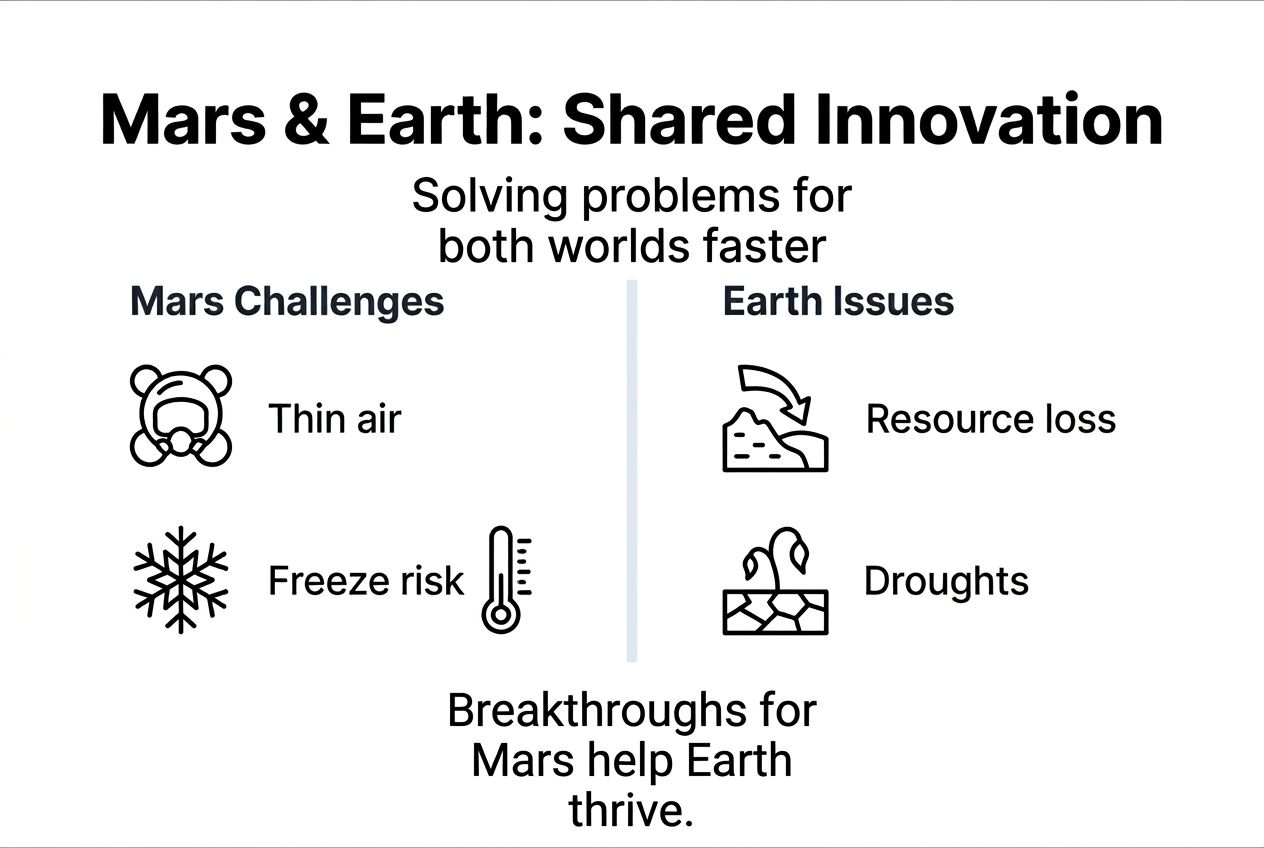
Both planets operate under brutal constraints that demand identical technological breakthroughs. Understanding these parallels clarifies why dual-planet innovation isn’t splitting focus but multiplying impact.
| Challenge Category | Mars Constraint | Earth Parallel | Shared Technology Need |
|---|---|---|---|
| Energy | No fossil fuels, limited solar | Renewable transition urgency | High-efficiency storage and generation |
| Water | No liquid surface water | Finite freshwater resources | Advanced purification and recycling |
| Food | No soil, no atmosphere | Urban food security gaps | Controlled environment agriculture |
| Air Quality | Unbreathable atmosphere | Pollution and climate change | Advanced filtration and CO2 management |
| Waste | Zero resupply missions | Landfill crisis and ocean plastic | Complete circular material systems |
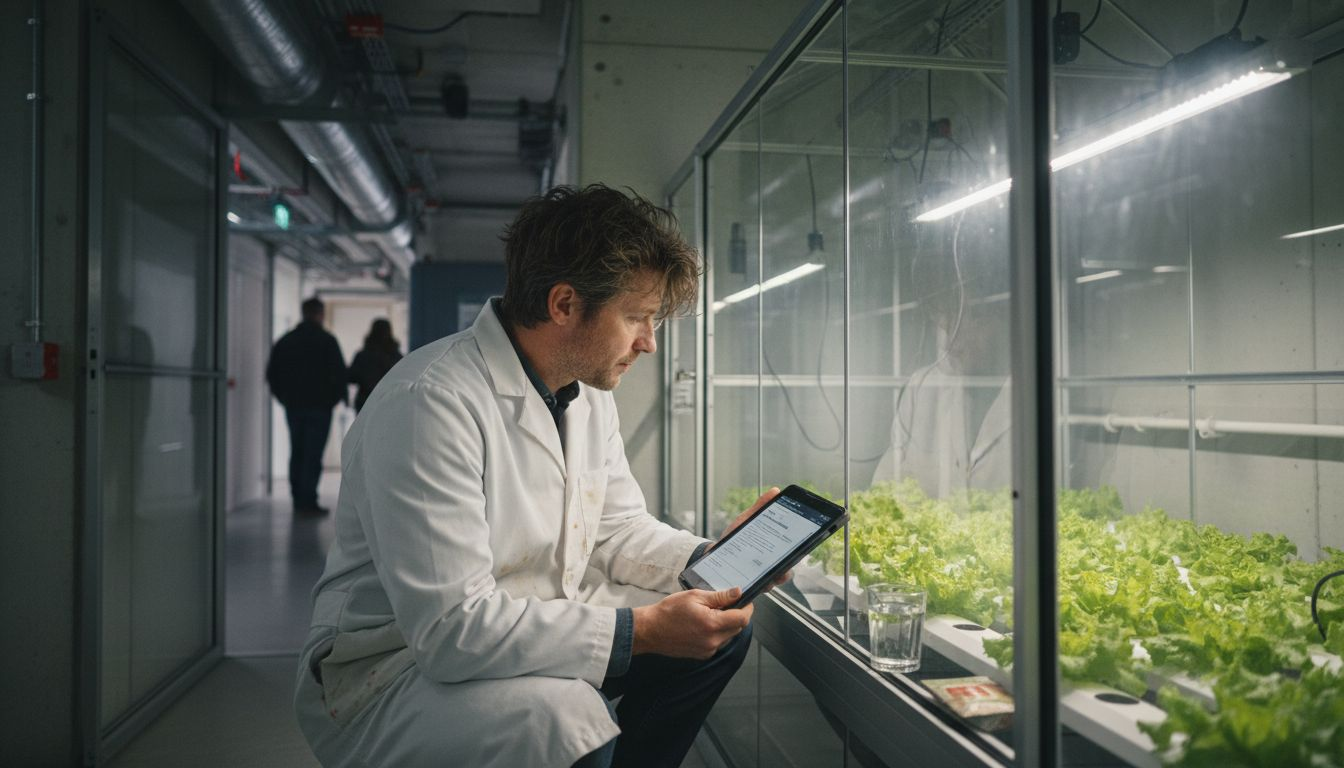
Resource scarcity on Mars forces innovations that Earth’s finite resources increasingly demand. When you design a Mars greenhouse that produces 30% more food per square meter using 90% less water, you’re simultaneously solving urban agriculture challenges in water-stressed Earth cities.
Energy efficiency becomes non-negotiable on Mars. You can’t waste a single watt when solar panels are your only power source and dust storms last months. This same ruthless efficiency thinking transforms Earth’s renewable energy deployment, making systems viable in challenging climates and remote locations.
Pro Tip: When evaluating sustainability solutions, ask whether they’d work on Mars. If the answer is no, they probably lack the resilience and efficiency Earth’s future demands.
Agricultural innovations developed for Mars habitats eliminate pesticides, optimize nutrient delivery, and maximize yield per input. These advances translate directly to vertical farms, rooftop gardens, and food production in climate-affected regions where traditional agriculture fails.
Breaking misconceptions: is Mars exploration a distraction from Earth?
This question assumes a zero-sum game. It ignores how space exploration technologies accelerate Earth solutions rather than competing for resources.
Over 60% of technologies NASA develops for space missions find immediate Earth applications in environmental monitoring, disaster response, water management, and renewable energy. The return on investment isn’t theoretical. It’s measurable in lives saved, emissions reduced, and resources conserved.
Consider these realities:
- Mars water purification systems reduce Earth treatment costs by 25% while improving output quality
- Life support technologies from space enable off-grid communities to achieve energy independence
- Remote sensing tools developed for Mars mapping now track Earth’s deforestation, ocean health, and atmospheric changes
- Closed-loop agriculture prototypes for Mars stations revolutionize urban farming efficiency
Mars exploration doesn’t drain Earth resources. It multiplies our capacity to solve shared survival challenges by testing solutions under conditions that demand they actually work.
The timeline argument strengthens the dual-planet case. Climate change requires solutions now, not decades from now. Mars missions compress development cycles because failure isn’t an option. Technologies must function perfectly in extreme conditions or crews die. This accelerated validation process delivers Earth-ready solutions faster than conventional development timelines.
Space exploration also drives practical innovation, not science fiction fantasies. Every system designed for Mars must be buildable with current technology, affordable at scale, and maintainable by small teams. These constraints ensure solutions remain grounded in reality and applicable to Earth’s immediate needs.
Mental models and frameworks for dual-planet innovation
Successful dual-planet thinking requires shifting from siloed problem-solving to integrated systems approaches. These frameworks organize complexity and reveal opportunities others miss.
Planetary resilience serves as the foundational mental model. It focuses on creating systems that adapt, self-repair, and thrive under stress. Whether you’re designing for Martian dust storms or Earth’s hurricanes, resilience thinking prioritizes flexibility over rigid optimization.
Next Human Learning builds the meta-skills dual-planet innovation demands. It develops ethical intelligence for navigating tradeoffs, collaboration abilities for diverse team success, and adaptive thinking for uncertain futures. These capabilities matter more than memorized facts when prototyping survival systems.
The cross-application innovation framework connects Mars technology development directly to Earth challenges:
- Identify a Mars survival constraint (water scarcity, energy limits, food production)
- Design the minimum viable solution that works in Martian conditions
- Map parallel Earth contexts facing similar constraints (deserts, islands, polar regions)
- Adapt the Mars prototype for Earth deployment with available materials
- Validate through real-world testing in both planetary contexts
- Iterate based on performance data from dual environments
- Scale successful solutions across similar Earth challenges
This systematic approach ensures innovations serve both planets simultaneously. It eliminates wasted effort on solutions that work only in single contexts.
Pro Tip: Avoid disciplinary silos when tackling dual-planet challenges. The best breakthroughs combine biology, engineering, social science, and design thinking. Seek diverse team perspectives to unlock possibilities specialists miss.
Systems thinking reveals how interventions in one area cascade through entire life-support networks. Optimizing water recycling affects energy consumption, which impacts food production capacity, which influences habitat design. Understanding these connections prevents unintended consequences and identifies leverage points for maximum impact.
Real-world case studies: Mars technologies improving Earth
Theory becomes tangible when you examine specific technologies making the jump from Mars missions to Earth applications with measurable sustainability gains.
Water purification systems engineered for Mars habitats now reduce treatment costs by 25% in Earth communities while eliminating chemical additives. The closed-loop approach recovers 98% of water from all sources, including humidity and waste streams. Remote villages, disaster zones, and water-stressed cities deploy these systems to achieve water security impossible with conventional infrastructure.
| Technology Area | Mars Application | Earth Benefit | Impact Metric |
|---|---|---|---|
| Water Systems | Habitat life support recycling | Community purification plants | 25% cost reduction, 98% recovery |
| Agriculture | Controlled environment food production | Urban vertical farms | 30% yield increase, 90% water savings |
| Energy Storage | Solar power for long Martian nights | Grid stabilization for renewables | 40% efficiency gain in off-grid systems |
| Air Management | Atmospheric processing and CO2 conversion | Industrial emission capture | 60% reduction in facility carbon output |
Agricultural innovations designed for Mars greenhouses boost Earth crop yields by up to 30% while slashing water consumption by 90%. LED lighting optimized for plant photosynthesis, nutrient delivery systems that eliminate waste, and atmospheric controls that maximize growth rates all transfer directly to urban farming operations. Cities facing food security challenges deploy these technologies to produce fresh vegetables year-round in minimal space.
Energy solutions prototyped for Mars stations enable renewable deployment in Earth’s harshest environments. Battery systems that survive temperature extremes, solar arrays that operate efficiently in low-light conditions, and power management that squeezes maximum output from limited generation all prove invaluable for off-grid communities and climate-affected regions.
Key sustainability outcomes from Mars technology applications include:
- Reduced resource consumption through extreme efficiency requirements
- Eliminated waste via closed-loop system mandates
- Improved resilience from designing for worst-case scenarios
- Accelerated innovation timelines driven by mission-critical needs
- Validated solutions tested under conditions exceeding Earth’s challenges
Empowering young innovators: how to engage with dual-planet challenges
You don’t need a PhD to contribute meaningful solutions. Young innovators aged 15-29 drive breakthroughs by bringing fresh perspectives unburdened by conventional thinking.
Joining dual-planet innovation platforms offers multiple benefits:
- Access to mentorship from sustainability and space exploration experts
- Structured frameworks that transform ideas into testable prototypes
- Diverse team collaboration that mirrors real-world professional environments
- Portfolio-building opportunities with tangible impact projects
- Global network connections spanning over 20 countries
Building skills and contributing to Mars/Earth sustainability projects follows clear steps:
- Identify a shared challenge between Mars survival and Earth sustainability that genuinely interests you
- Research existing solutions and identify gaps where innovation could make measurable differences
- Assemble a deliberately diverse team combining different disciplines, backgrounds, and thinking styles
- Prototype minimum viable solutions using available materials and technologies
- Test assumptions through experiments that validate or disprove your approach
- Iterate based on evidence, not opinions or preferences
- Document your process to share learnings with the global community
- Present refined solutions at events like The Grand Jam 2026
Participation in dual-planet challenges develops meta-skills employers desperately seek. You gain ethical intelligence for navigating complex tradeoffs between competing values. You build collaboration capabilities through team-based problem-solving under constraints. You develop adaptability by working through uncertainty without clear answers.
Communities like Mars Challenge provide structured pathways from curiosity to impact. You learn how to participate through tiered programs matching your current skill level while pushing growth.
Pro Tip: Leverage interdisciplinary learning by deliberately seeking knowledge outside your comfort zone. If you’re an engineer, study ecology. If you’re a designer, explore systems thinking. The intersections between fields unlock breakthrough insights.
Running innovation challenges with youth teams builds leadership experience while multiplying impact. Empowering education for future climate innovation starts with small steps that compound into transformative capabilities.
Join the mission: dual-planet innovation with Mars Challenge
Mars Challenge transforms dual-planet theory into hands-on experience. This global platform connects you with structured programs that turn sustainability passion into measurable impact. You’ll join deliberately diverse teams tackling real challenges in energy, food systems, climate solutions, and technology.
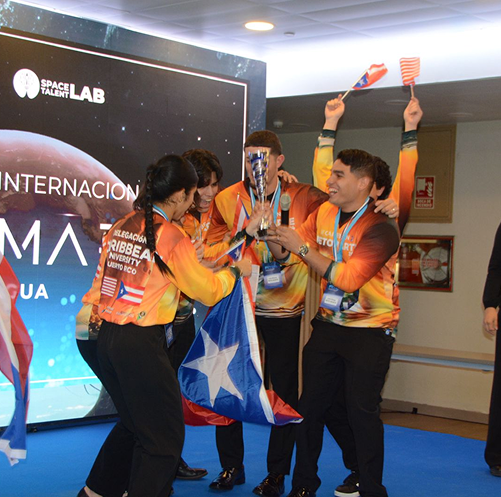
The Next Human Learning methodology builds meta-skills traditional education misses: ethical intelligence, collective innovation, and resilience thinking. You’ll prototype actual solutions, receive expert mentorship, and present at The Grand Jam 2026 alongside innovators from over 20 countries.
Discover how to participate in challenges designed for young innovators aged 15-29. Explore your role in sustainability innovation and find alternatives to conventional competitions that prioritize learning and impact over rankings. This isn’t just another contest. It’s a movement redefining how we solve humanity’s survival challenges.
Frequently asked questions
Is Mars exploration taking resources away from Earth’s urgent problems?
No. Mars technologies generate more Earth benefits than they consume in development costs. Over 60% of space exploration innovations directly improve environmental monitoring, disaster response, water systems, and renewable energy on Earth. The dual-planet approach accelerates solutions by testing them under extreme conditions that validate real-world performance.
How can technologies designed for Mars improve life on Earth?
Mars demands zero-waste, maximum-efficiency systems that Earth’s sustainability increasingly requires. Water purification tech from Mars habitats reduces Earth treatment costs by 25%. Agricultural innovations boost yields 30% while cutting water use 90%. Energy systems prototyped for Mars enable renewable deployment in challenging Earth environments where conventional approaches fail.
What skills do young innovators gain by working on dual-planet challenges?
You develop meta-skills that matter more than memorized facts: ethical intelligence for navigating complex tradeoffs, collaboration abilities for diverse team success, and adaptive thinking for uncertain futures. Technical capabilities in systems thinking, prototyping, and evidence-based iteration prepare you for careers solving real-world challenges. These competencies transfer across industries and remain relevant as technology evolves.
How does planetary resilience help in sustainability innovation?
Planetary resilience focuses on creating systems that adapt, self-repair, and thrive under stress rather than optimizing for single scenarios. This mental model applies whether you’re designing for Martian dust storms or Earth’s climate disruptions. Resilience thinking prioritizes flexibility, redundancy, and graceful degradation, ensuring solutions remain functional when conditions shift unexpectedly.
Where can I get involved in Mars and Earth sustainability projects?
Mars Challenge offers structured programs across over 20 countries for innovators aged 15-29. You can join local communities, participate in team-based challenges, access mentorship, and present solutions at global events. The platform provides frameworks, resources, and connections that transform ideas into tested prototypes with measurable impact on both planetary contexts.
What makes dual-planet innovation different from traditional sustainability approaches?
Dual-planet thinking compresses development timelines by demanding solutions work under extreme constraints. It eliminates theoretical approaches that sound good but fail in practice. The cross-application framework ensures technologies serve multiple contexts simultaneously, multiplying return on innovation investment. You validate solutions faster and deploy them wider than Earth-only approaches allow.